AI Tutor for College Students: Complete Guide
 By Ayan Sarkar
17 min read
College learning is becoming increasingly digital, and artificial intelligence is now part of how many students research topics, prepare for exams, practise skills, write, code, and understand difficult concepts. An AI tutor can add another layer of learning support by allowing students to ask questions, receive explanations, practise problems, and get feedback through an interactive conversation.
The growing use of AI among university students is not simply a prediction. A 2025 Chegg Global Student Survey found that 80% of surveyed undergraduates across 15 countries had used generative AI to support their university studies. Among students who used GenAI for studying, 56% said they primarily used it to understand concepts or subjects. At the same time, 53% were concerned about receiving inaccurate information.
This combination of adoption and caution explains why the idea of an AI tutor is becoming important in higher education. Students want faster and more personalized assistance, but they also need reliable information, academic integrity, privacy, and opportunities to develop their own thinking.
What Is an AI Tutor for College Students?
An AI tutor is an artificial intelligence-powered learning system designed to provide students with interactive academic support.
Unlike a conventional search engine, which primarily helps users find information, an AI tutor can participate in a learning conversation. A student can ask a question, receive an explanation, ask a follow-up question, request an example, attempt a problem, and then ask for feedback.
For example, a college student studying programming could ask:
“Explain object-oriented programming in simple terms.”
After receiving an explanation, the student could continue:
“Give me a real-world example.”
Then:
“Create a small programming exercise so I can practise it.”
This conversational process is one of the main differences between using AI simply as an information source and using it as a learning assistant.
An effective AI tutor can potentially support:
- Concept explanations
- Step-by-step problem solving
- Exam preparation
- Practice questions
- Coding assistance
- Writing and brainstorming support
- Revision
- Feedback
- Language learning
- Research preparation
- Study planning
- Skill development
However, an AI tutor should support learning rather than replace the student’s own effort or the role of professors, lecturers, teaching assistants, and other educators.
Why Are College Students Using AI for Learning?
AI adoption among university students has increased rapidly.
A 2025 Higher Education Policy Institute survey of 1,041 full-time UK undergraduates found that 92% had used AI in some form, compared with 66% in 2024. The survey also found that 88% had used generative AI for assessments. Common uses included explaining concepts, summarising articles, and generating research ideas.
A separate UCLA survey of 6,639 graduating students from the Class of 2025 found that 73% had used generative AI to support coursework. The most commonly reported uses included researching a topic, brainstorming for writing or presentations, and studying for exams.
These figures show that AI is already part of many students’ academic workflows. The more important question is therefore not simply whether students use AI, but how they use it.
Using AI to obtain an answer without understanding the underlying concept can create a very different learning experience from using AI to receive hints, explanations, questions, and feedback.
How Does an AI Tutor Work?
Most modern AI tutors use several technologies to create conversational learning experiences.
1. Natural Language Processing
Natural language processing allows AI systems to interpret questions written in everyday language.
A student does not necessarily need to use technical terminology. They can ask:
“Why does this formula work?”
or:
“I don’t understand this chapter. Can you explain the main idea?”
The system attempts to interpret the meaning and context of the question.
2. Large Language Models
Large language models, or LLMs, can generate explanations and responses based on patterns learned from large datasets.
This makes it possible for AI tutors to respond to open-ended questions rather than relying entirely on fixed answers.
3. Personalization
Some AI learning systems use information from the interaction to adapt explanations, difficulty, examples, or practice activities.
For example, if a student demonstrates that they understand basic Python variables but struggle with functions, an AI tutor can focus more heavily on functions rather than repeating concepts the student already understands.
4. Feedback and Practice
An AI tutor can generate practice questions and respond to a student’s attempt.
For example:
“Give me five questions about probability, but don’t show the answers.”
After completing them, a student could ask:
“Check my answers and explain where I went wrong.”
This creates a feedback loop that can make independent study more interactive.
5. Retrieval and Educational Content
More advanced systems can connect AI models with curated educational materials, databases, course content, or other trusted sources.
This approach can help reduce the risk of generating unsupported information, although it does not eliminate the need for students to verify important information.
What Can College Students Use an AI Tutor For?
An AI tutor can support different stages of the college learning process.
Understanding Difficult Subjects
College subjects can become highly specialised. Students may encounter advanced mathematics, programming concepts, scientific theories, economics, statistics, accounting, engineering principles, or technical terminology.
An AI tutor can explain the same concept at different levels.
For example:
“Explain quantum computing at a beginner level.”
Then:
“Now explain the same concept using a university-level explanation.”
This ability to request another explanation can be useful when a textbook or lecture does not immediately make sense.
Exam Preparation
Students can use AI to create revision questions, flashcards, practice tests, summaries, and explanations.
A useful workflow is:
- Study the original material.
- Ask the AI tutor to generate practice questions.
- Answer the questions independently.
- Request feedback.
- Review mistakes.
- Repeat the difficult areas.
This makes AI part of a deliberate study process rather than simply an answer generator.
Programming and Coding
Programming is particularly suitable for interactive learning because students often need immediate explanations of errors and concepts.
Students can ask:
- “Why is this Python code producing an error?”
- “Give me a hint without giving me the solution.”
- “Explain this function line by line.”
- “Create a similar problem for me to solve.”
- “Review my approach but don’t rewrite the entire program.”
Students who want to learn Python with AI can use AI to explain syntax, generate exercises, discuss errors, and practise problem-solving while still writing and testing their own code.
The distinction is important: receiving a complete solution is not the same as learning how to solve the problem.
Research and Writing
AI can help students brainstorm research questions, organise ideas, clarify concepts, compare arguments, and identify areas that require further investigation.
However, students should verify factual claims, citations, quotations, statistics, and references independently.
AI-generated references can sometimes be incorrect or nonexistent, and AI systems can produce confident-sounding explanations that are inaccurate.
Career and Technical Skills
College education increasingly overlaps with professional skill development.
Students studying computer science, information technology, business, data, design, or other technology-related disciplines may use AI to practise technical concepts and explore career-related skills.
Students exploring job-ready tech courses can also use AI as a learning companion while developing practical knowledge in areas such as programming, artificial intelligence, data science, cloud computing, cybersecurity, and software development.
AI Tutor vs Traditional Learning
The discussion around AI tutor vs traditional learning is often presented as if students must choose one or the other. In practice, the two approaches can serve different purposes.
Traditional college education provides structured curricula, instructors, peer interaction, laboratories, projects, assessments, mentorship, and institutional resources.
An AI tutor can provide additional conversational support, immediate explanations, practice opportunities, and flexible study assistance.
| Learning factor | Traditional learning | AI-supported learning |
| Instruction | Professor or instructor-led | AI-assisted |
| Feedback | Often scheduled | Can be immediate |
| Personalization | Depends on course and instructor | Can adapt conversationally |
| Availability | Based on classes and office hours | Generally available on demand |
| Peer interaction | Strong | Usually limited |
| Human mentorship | Strong | Limited |
| Practice generation | Instructor or course materials | Can generate additional exercises |
| Information verification | Academic sources and instructors | Requires student verification |
| Emotional and social context | Human interaction | Limited |
| Curriculum structure | Usually formal | Depends on the platform |
Research does not support treating every AI tool as automatically superior to traditional education.
For example, a 2025 randomized controlled trial involving college students found that a specially designed AI tutor produced significantly greater learning in less time than an active-learning classroom condition. However, the study used a purpose-built tutor designed around established pedagogical principles, rather than demonstrating that every general-purpose chatbot produces the same result.
Conversely, a 2026 randomized controlled field experiment involving approximately 500 undergraduates found no statistically significant effect from a generative-AI chatbot on measured learning-related outcomes. The researchers highlighted the need for more evidence before assuming that AI chatbots automatically improve higher-education learning.
The evidence therefore suggests that the educational design of an AI system matters.
AI Is Changing Personalized Learning
Personalization is one of the most important reasons AI tutors are attracting attention in higher education.
Students do not enter a classroom with identical levels of prior knowledge. One student may already understand basic programming, while another may be learning their first programming language. Similarly, students can differ in mathematical background, vocabulary, study habits, and familiarity with technical subjects.
AI is changing personalized learning by making it possible to interact with educational systems through natural-language questions and follow-up conversations.
For example, a student could request:
“Explain recursion using a simple example.”
If that explanation is difficult to understand:
“Explain it without technical terminology.”
Then:
“Give me a visual analogy.”
Then:
“Give me a problem to solve myself.”
This sequence demonstrates how AI can adapt the interaction to the learner’s immediate needs.
However, personalization should not be confused with guaranteed educational effectiveness. An AI system can generate a highly personalised response that is still inaccurate, incomplete, or pedagogically inappropriate.
What Are the Benefits of AI Tutors for Students?
When used appropriately, AI tutors for students can provide several forms of additional academic support.
1. Immediate explanations
Students can ask questions when confusion occurs instead of waiting until the next class.
2. Self-paced learning
Students can revisit difficult concepts as many times as necessary.
3. Additional practice
AI can generate exercises based on a topic, difficulty level, or learning objective.
4. Conversational interaction
Students can ask follow-up questions instead of searching through multiple disconnected resources.
5. Coding support
AI can explain errors, concepts, algorithms, syntax, and programming approaches.
6. Revision assistance
Students can create quizzes, summaries, flashcards, and practice questions.
7. Flexible study support
AI-based learning can be accessed outside conventional classroom schedules.
8. Different explanation styles
Students can request examples, analogies, simplified explanations, technical explanations, or step-by-step guidance.
A 2025 systematic review and meta-analysis covering 57 studies and 97 effect estimates reported positive overall effects of generative AI on university students’ learning outcomes, including academic achievement and higher-order thinking. However, the researchers also found no statistically significant effect on metacognition and identified substantial variation depending on context and study characteristics.
This is an important distinction: AI can support learning, but the effect depends on how the technology is integrated into the learning process.
What Are the Limitations of AI Tutors?
AI tutoring also comes with important limitations.
Inaccurate information
AI systems can generate incorrect answers, outdated information, or misleading explanations.
Accuracy is one of the biggest concerns among students. In Chegg’s 2025 global survey, 53% of students who had used GenAI for university studies were concerned about receiving incorrect or inaccurate information.
Overdependence
If students ask AI to solve every problem, they may reduce opportunities to practise independent reasoning.
For example, asking for a complete solution every time a programming exercise becomes difficult may produce a working program without developing programming ability.
Academic integrity
Universities have different rules about AI use.
Some courses may permit brainstorming or proofreading but prohibit AI-generated answers in submitted work. Other courses may have different requirements.
Students should always check their institution’s and instructor’s policies before using AI for assessed work.
Privacy
Students should be cautious about entering sensitive personal information, unpublished research, confidential university documents, or private information into AI systems.
UNESCO’s guidance on generative AI in education emphasises privacy protection, ethical use, human-centred design, and appropriate institutional policies.
Limited human understanding
An AI system can simulate a conversational teaching interaction, but it does not replace the full range of human educational relationships.
Professors and teachers provide mentorship, disciplinary expertise, contextual judgement, social interaction, and feedback that extends beyond answering questions.
How Should College Students Use AI Tutors Responsibly?
The most effective approach is to treat AI as a learning assistant rather than a substitute for learning.
Use AI for explanations
Ask AI to explain concepts you do not understand.
Ask for hints before solutions
Instead of:
“Solve this problem.”
Try:
“Give me a hint for the first step.”
This keeps more of the problem-solving process with the student.
Make AI question you
Students can ask:
“Quiz me on this chapter one question at a time.”
This changes the interaction from passive reading to active recall.
Verify important information
For academic research, compare AI-generated information with textbooks, peer-reviewed research, official documentation, university resources, or other authoritative sources.
Practise without AI
After learning with AI, close the tool and solve a similar problem independently.
This provides a simple way to check whether the knowledge has actually been retained.
Follow university policies
Before using AI for an assignment, check the relevant course instructions.
AI use that is permitted for brainstorming may not necessarily be permitted for producing final submitted work.
How to Write Better Prompts for an AI Tutor
The quality of an AI learning interaction often depends on the quality of the question.
Instead of:
“Explain calculus.”
Try:
“I’m a first-year college student. Explain derivatives using a simple real-world example, then give me three practice questions without answers.”
For programming:
“I’m learning Python. Explain why this code produces an error, but don’t rewrite the complete solution. Give me a hint so I can fix it myself.”
For exam preparation:
“I’m preparing for a university exam on database management. Create 10 conceptual questions from beginner to advanced difficulty. Don’t provide the answers until I attempt them.”
For revision:
“Quiz me on these concepts one at a time. After each answer, tell me whether my reasoning is correct and explain any mistake.”
These prompts give the AI tutor a learning role rather than simply requesting information.
A Practical AI Tutor Study Method for College Students
A simple five-stage process can make AI-assisted learning more useful.
Step 1: Learn
Start with your textbook, lecture, course material, laboratory session, or other approved educational resource.
Step 2: Identify gaps
Write down concepts you do not understand.
Step 3: Ask the AI tutor
Request an explanation, example, analogy, or hint.
Step 4: Practise independently
Solve a similar question without AI assistance.
Step 5: Verify
Check your understanding against reliable academic resources or ask your instructor when the issue is important or unclear.
This creates a learning loop:
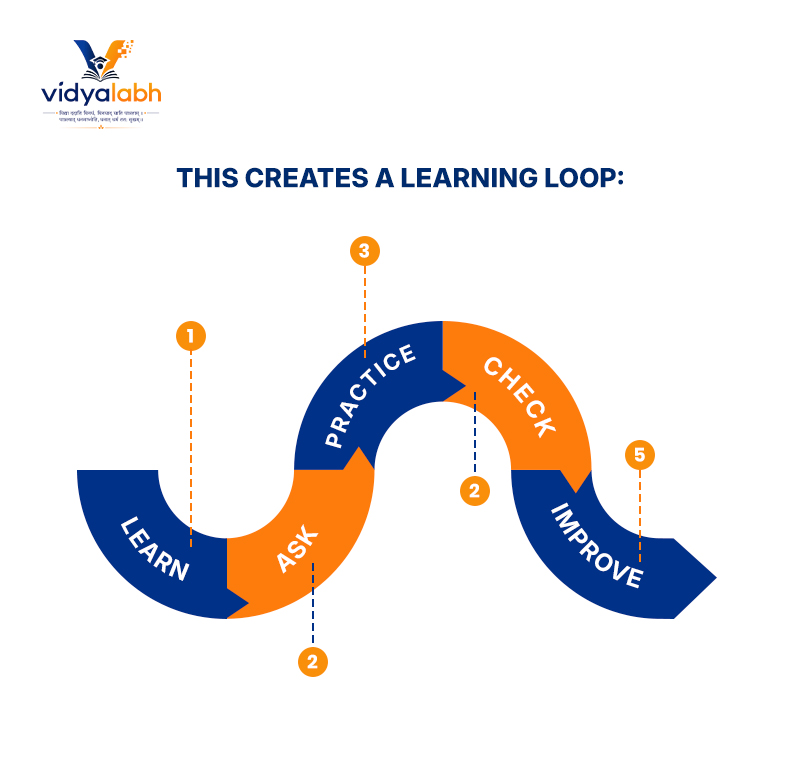
The student remains at the centre of the process.
How to Choose an AI Tutor for College
College students should evaluate an AI tutor according to their actual learning requirements rather than choosing a tool solely because it is popular.
Consider these factors:
Subject coverage
Does the system support the subjects you study?
Explanation quality
Can it explain difficult topics at different levels?
Personalization
Can you ask follow-up questions and adapt the interaction to your knowledge level?
Practice features
Can it create quizzes, exercises, coding tasks, or other forms of active practice?
Feedback
Can it evaluate your attempts and explain mistakes?
Reliability
Does the system provide ways to verify information or connect answers to reliable educational material?
Privacy
Understand what data the platform collects and how it is used.
Academic-integrity support
The tool should be used in ways that align with your university’s policies.
Ease of use
A complicated interface can create friction during regular study.
Is an AI Tutor Better Than a Professor?
An AI tutor and a professor perform different roles.
A professor can design a curriculum, understand classroom dynamics, evaluate nuanced work, provide mentorship, conduct research, supervise projects, and understand institutional and disciplinary contexts.
An AI tutor can provide conversational explanations, generate practice questions, respond quickly, and support independent study.
For many students, the useful model is therefore not replacing one with the other but combining them appropriately.
AI can handle additional practice and routine explanations, while instructors remain important for complex academic guidance, assessment, mentorship, and human interaction.
Is AI Tutoring Effective for College Students?
Research indicates that AI-assisted learning can improve some educational outcomes, but the evidence is not uniform.
A 2025 meta-analysis of 57 studies reported positive effects across several learning outcomes, while also finding differences depending on the learners, intervention duration, context, and other factors.
A separate randomized controlled study found strong results for a purpose-built AI tutor compared with active learning in a college setting.
At the same time, a 2026 field experiment involving approximately 500 undergraduates found no statistically significant effect from a generative-AI chatbot across the measured outcomes.
These findings point to an important conclusion for students: simply having access to AI does not guarantee better learning. How the AI is designed and how the student uses it matter.
Frequently Asked Questions About AI Tutors for College Students
What is an AI tutor?
An AI tutor is an artificial intelligence-powered learning system that provides interactive support through explanations, questions, practice, feedback, and conversational learning.
Can college students use AI tutors for studying?
Yes. College students can use AI tutors for concept explanations, revision, practice questions, programming assistance, brainstorming, and other learning activities, provided their use follows relevant academic policies.
Can an AI tutor replace a college professor?
No single AI tutor can fully replace the educational role of a professor. AI can provide additional academic support, while professors provide teaching, mentorship, assessment, disciplinary expertise, and human interaction.
Can AI tutors help with programming?
Yes. AI tutors can explain programming concepts, identify possible errors, generate practice problems, review code, and provide hints. Students should still write, test, and understand their own code.
Can AI tutors help with exam preparation?
They can assist by generating practice questions, explaining difficult concepts, creating revision exercises, and testing students through interactive quizzes.
Is AI-generated information always accurate?
No. AI systems can produce incorrect or incomplete information. Important academic claims should be verified against reliable sources.
Is it acceptable to use an AI tutor for college assignments?
That depends on the institution, instructor, course, and assignment. Students should check the applicable academic-integrity policy before using AI for assessed work.
How can students avoid becoming dependent on AI?
Students can attempt problems independently, ask for hints rather than complete answers, practise without AI, explain concepts in their own words, and verify their understanding through independent exercises.
What should students look for in an AI tutor?
Important factors include subject coverage, personalization, practice features, feedback, reliability, privacy, usability, and compatibility with academic-integrity requirements.
Final Thoughts
An AI tutor can give college students another way to learn outside conventional classroom interactions. It can explain difficult concepts, provide practice questions, support coding, assist with revision, and respond to follow-up questions when students are studying independently.
However, the technology is most useful when students remain actively involved in the learning process.
The strongest approach is not simply to ask AI for answers. Students can use it to ask better questions, receive explanations, practise skills, identify gaps in understanding, and obtain feedback before attempting similar problems independently.
Current research shows both promising results and important limitations. Some controlled studies have found substantial learning benefits from purpose-built AI tutoring systems, while other research has found limited or no measurable benefit from general AI chatbot interventions.
For college students, the practical lesson is straightforward: use AI to strengthen learning, not to bypass it.
When combined with university teaching, reliable academic sources, independent practice, critical thinking, and responsible use, AI tutoring can become a useful component of a modern college student’s learning toolkit.