Best Job-Ready Tech Courses to Start a Career in 2027
 By Ayan Sarkar
11 min read
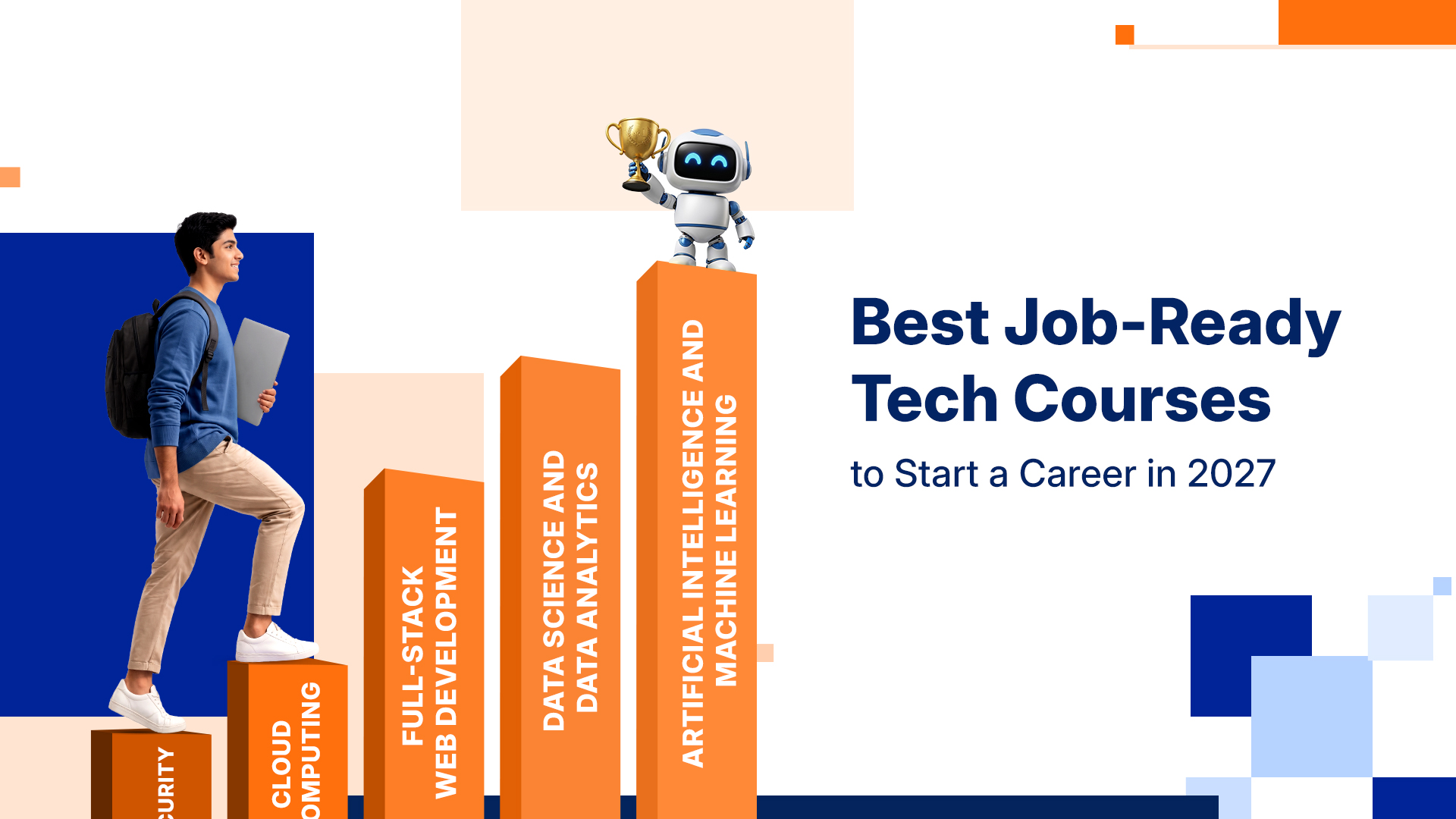
The technology job market is changing quickly, and the skills employers look for in 2027 are likely to extend beyond traditional programming. Artificial intelligence, cloud computing, cybersecurity, data, software development, and automation are becoming important across industries.
For students, graduates, and career changers, the challenge is not simply finding a technology course. It is choosing a course that develops practical, job-relevant skills and provides enough hands-on experience to build a portfolio.
Current workforce and skilling initiatives already emphasize areas such as artificial intelligence, machine learning, data science, cybersecurity, cloud computing, robotics, and other emerging technologies.
What Are the Best Job-Ready Tech Courses for 2027?
The most relevant technology courses to consider for a career in 2027 include:
- Artificial Intelligence and Machine Learning
- Data Science and Data Analytics
- Full-Stack Web Development
- Cloud Computing
- Cybersecurity
- DevOps and Automation
- Software Testing and Quality Assurance
- AI-Assisted Programming and Software Development
There is no single course that is suitable for everyone. The right choice depends on your educational background, interests, existing skills, career goals, and the amount of time you can dedicate to learning.
The common factor across these areas is the need for practical skills rather than only theoretical knowledge.
1. Artificial Intelligence and Machine Learning
Artificial Intelligence and Machine Learning are among the most important technology areas to understand as organizations increasingly use AI for automation, prediction, content generation, customer support, analytics, and decision-making.
A beginner-focused AI and ML course can introduce concepts such as:
- Python programming
- Statistics and probability
- Machine learning algorithms
- Data preprocessing
- Model training and evaluation
- Natural language processing
- Generative AI
- Large language models
- AI applications
India’s current government-backed skilling ecosystem includes AI, machine learning, generative AI, agentic AI, large language models, prompt engineering, deep learning, NLP, computer vision, AI security, and AI governance among emerging areas.
Who should learn AI and ML?
AI and ML can be suitable for students who enjoy mathematics, programming, data, and problem-solving. Beginners should generally start with Python, basic mathematics, and data handling before moving into advanced machine learning concepts.
2. Data Science and Data Analytics
Businesses generate large amounts of data, creating a need for professionals who can transform raw information into useful insights.
A data-focused course may cover:
- Python
- SQL
- Excel
- Statistics
- Data cleaning
- Data visualization
- Power BI or similar BI tools
- Exploratory data analysis
- Basic machine learning
Data analytics can also provide a foundation for more advanced AI and machine learning learning paths. Technical skills such as Python and SQL are widely used across analytics, automation, software, and cloud-related work.
For beginners who are interested in working with numbers and business information but do not want to immediately pursue advanced AI, data analytics can be a practical starting point.
3. Full-Stack Web Development
Web development remains an important technology skill because businesses continue to need websites, web applications, dashboards, e-commerce systems, and internal software.
A typical full-stack development learning path includes:
Frontend
- HTML
- CSS
- JavaScript
- React or another modern framework
Backend
- Node.js, Python, Java, or another backend language
- APIs
- Databases
- Authentication
Development practices
- Git and GitHub
- Testing
- Deployment
- Basic cloud services
The biggest advantage of a development course is that learners can demonstrate their skills through projects.
Instead of simply listing “JavaScript” or “React” on a résumé, a learner can create a portfolio containing websites, dashboards, APIs, or complete applications.
4. Cloud Computing
Modern applications increasingly depend on cloud infrastructure. As a result, understanding cloud platforms and infrastructure can be valuable for developers, system administrators, data professionals, and IT specialists.
A beginner cloud course may introduce:
- Cloud computing fundamentals
- Virtual machines
- Storage
- Networking
- Databases
- Identity and access management
- Containers
- Cloud security
- AWS, Microsoft Azure, or Google Cloud
- Monitoring and deployment
Cloud computing is also increasingly connected with DevOps, cybersecurity, software development, and data engineering.
For beginners, it is usually more useful to understand fundamental cloud concepts before focusing heavily on vendor-specific certifications.
5. Cybersecurity
As organizations become increasingly dependent on digital systems, cybersecurity has become an important technology discipline.
A cybersecurity course can introduce learners to:
- Networking fundamentals
- Operating systems
- Security principles
- Threat detection
- Vulnerability assessment
- Identity and access management
- Security monitoring
- Incident response
- Security tools
- Basic ethical hacking concepts
Cybersecurity is also evolving alongside artificial intelligence. Recent industry reporting highlights increasing demand for cybersecurity professionals who understand AI-related risks and technologies.
A strong starting point for beginners is to learn networking and operating-system fundamentals before moving into advanced security topics.
6. DevOps and Automation
DevOps combines software development and IT operations to improve how applications are developed, tested, deployed, and maintained.
A DevOps learning path may include:
- Linux
- Git
- CI/CD
- Docker
- Kubernetes
- Cloud platforms
- Infrastructure as code
- Monitoring
- Automation
DevOps is particularly useful for learners who enjoy understanding how applications move from development environments into production.
It can also complement full-stack development and cloud computing skills.
7. Software Testing and Quality Assurance
Not every technology career requires becoming a full-time software developer.
Software testing and quality assurance focus on ensuring that applications work correctly, reliably, and securely.
A beginner course may cover:
- Manual testing
- Test cases
- Bug reporting
- Functional testing
- Regression testing
- API testing
- Automation testing
- Selenium or similar tools
- Basic programming
This can be an option for learners who enjoy finding problems, analyzing application behavior, and working systematically.
8. AI-Assisted Programming and Software Development
Learning programming in 2027 will increasingly involve working alongside AI-powered development tools.
However, using AI to generate code is not the same as understanding programming.
A job-ready developer should still understand:
- Programming fundamentals
- Data structures
- Algorithms
- Debugging
- APIs
- Databases
- Version control
- Software architecture
- Testing
AI can then be used to support activities such as code explanation, debugging, documentation, brainstorming, and practice.
This is also where an AI learning assistant can become useful during the learning process. For example, students can use an AI tutor to ask follow-up questions, request alternative explanations, practice concepts, or get guidance while working through programming problems.
Platforms such as Vidyalabh are designed around this type of AI-supported learning experience, giving learners an additional way to interact with educational content and get personalized learning support.
Which Tech Course Should a Beginner Choose in 2027?
The answer depends largely on your interests and starting point.
| Your Interest | Possible Learning Path |
| Building websites and applications | Full-Stack Development |
| Working with numbers and business data | Data Analytics |
| Building intelligent applications | AI and Machine Learning |
| Working with cloud infrastructure | Cloud Computing |
| Protecting systems and networks | Cybersecurity |
| Automating development and deployment | DevOps |
| Finding software problems | Software Testing |
| Programming with modern AI tools | AI-Assisted Software Development |
This approach is more useful than choosing a course simply because it appears on a “top courses” list.
What Makes a Tech Course Job-Ready?
A course becomes more useful for employment when it goes beyond watching videos or completing theoretical lessons.
Look for these elements:
1. Strong Fundamentals
Before learning advanced tools, understand the concepts behind them.
For example, a data analyst should understand data and statistics rather than simply knowing how to click through a visualization tool.
2. Hands-On Projects
Projects allow learners to demonstrate that they can apply what they have learned.
Examples include:
- Building a web application
- Creating a data dashboard
- Developing a machine learning model
- Deploying an application to the cloud
- Creating an automated testing framework
- Building a cybersecurity lab
3. Problem-Solving Practice
Employers often need people who can solve unfamiliar problems, not simply reproduce examples from a course.
Regular exercises, coding challenges, case studies, and practical assignments can help develop this ability.
4. Portfolio Development
A portfolio gives employers something concrete to evaluate.
For technology students, a portfolio might include GitHub repositories, deployed applications, dashboards, technical documentation, or project demonstrations.
5. AI Literacy
AI is becoming relevant across many technical disciplines rather than existing as a completely separate career skill.
Learning how to use AI tools responsibly for research, coding, analysis, documentation, and productivity can complement core technical knowledge.
How Can AI Help You Learn a Tech Course?
Learning a technical subject often involves repeated questions.
A learner might understand one programming example but struggle with another. They may encounter an error message, misunderstand a concept, or need another explanation.
An AI tutor can provide support in situations such as:
- Explaining a difficult technical concept
- Breaking complex topics into smaller steps
- Generating practice questions
- Reviewing programming errors
- Providing examples
- Creating revision exercises
- Helping learners identify gaps in understanding
This does not replace structured learning, projects, documentation, or human guidance. Instead, it can work as an additional learning layer.
For example, a student learning Python can use an AI tutor to ask why a particular piece of code produces an error and then request a simpler explanation or another practice problem.
Vidyalabh approaches AI learning support in this direction, combining learning resources with AI-powered assistance and progress-oriented features. Its platform includes courses in areas such as JavaScript and data science with Python, alongside AI-based learning features.
How to Choose a Job-Ready Tech Course for 2027
Before enrolling in a course, ask these questions:
Does the course teach fundamentals?
A course should explain the underlying concepts instead of focusing entirely on tools.
Does it include practical projects?
Projects help convert theoretical knowledge into demonstrable skills.
Is the curriculum current?
Technology changes quickly. Check whether the course covers relevant technologies and development practices.
Can I build a portfolio from it?
A portfolio can help demonstrate your capabilities during internships and job applications.
Does it provide opportunities for practice?
Regular exercises and projects are generally more useful than passive video consumption.
Can I get help when I am stuck?
Access to instructors, communities, mentors, or AI learning assistance can make it easier to overcome learning obstacles.
A Simple Tech Career Roadmap for Beginners
If you are starting from zero, avoid trying to learn everything at once.
A practical roadmap can look like this:
Step 1: Build digital and programming fundamentals
Understand computers, the internet, basic programming concepts, and problem-solving.
Step 2: Choose one specialization
Select one primary path such as development, data, AI, cloud, cybersecurity, or testing.
Step 3: Learn the core tools
Focus on the technologies commonly used in that specialization.
Step 4: Build projects
Create progressively more challenging projects rather than only completing tutorials.
Step 5: Use AI as a learning assistant
Use AI to explain concepts, generate practice exercises, troubleshoot errors, and review your understanding.
Step 6: Build a portfolio
Document your projects and make your work easy for potential employers to evaluate.
Step 7: Prepare for real-world work
Practice technical interviews, communication, teamwork, documentation, and problem-solving.
Are Online Tech Courses Enough to Get a Job?
An online course can help develop relevant knowledge and skills, but completing a course alone does not guarantee employment.
Job readiness usually requires a combination of:
- Technical knowledge
- Practical projects
- Problem-solving ability
- Portfolio evidence
- Communication skills
- Interview preparation
- Continuous learning
The goal should therefore be skill development rather than simply collecting certificates.
Frequently Asked Questions
Which tech course is best for a job in 2027?
There is no universally best tech course. AI and machine learning, data analytics, full-stack development, cloud computing, cybersecurity, DevOps, and software testing are all relevant areas. The appropriate choice depends on your interests, existing skills, and career goals.
Which tech course is easiest for beginners?
Data analytics, basic web development, and software testing can be accessible starting points for some beginners. However, difficulty depends on your previous education, technical background, and learning approach.
Can non-technical students learn tech skills?
Yes. Many technology skills can be learned by beginners from non-technical backgrounds. Starting with fundamentals and choosing a learning path that matches your interests can make the transition more manageable.
Should I learn AI even if I am not studying AI or machine learning?
Learning basic AI literacy can be useful even if AI is not your primary specialization. AI tools are increasingly being used across software development, analytics, cybersecurity, marketing, education, and other fields.
Are certificates enough to get a tech job?
Certificates can demonstrate that you completed a learning program, but they are only one part of a job application. Practical projects, technical skills, portfolios, and interview performance can also be important.
How can an AI tutor help with technical courses?
An AI tutor can provide explanations, answer questions, create practice exercises, help troubleshoot programming errors, and adapt explanations to the learner’s level. It works best as a supplement to structured courses and hands-on practice.
Final Takeaway
The most useful tech course for starting a career in 2027 is not necessarily the one with the most popular title. It is the one that helps you develop relevant technical knowledge, practical experience, problem-solving ability, and a portfolio of real work.
AI and machine learning, data analytics, full-stack development, cloud computing, cybersecurity, DevOps, software testing, and AI-assisted development are important areas to explore. Current skilling initiatives and technology-learning resources also reflect growing emphasis on these capabilities.
For learners who want additional support while developing these skills, an AI learning platform such as Vidyalabh can complement structured courses by providing interactive, personalized assistance during the learning process. The key is to combine AI-supported learning with fundamentals, hands-on projects, and consistent practice.
Ultimately, becoming job-ready is a process: choose one direction, learn the fundamentals, practice consistently, build projects, use modern tools responsibly, and keep improving your skills.