What Is an AI Tutor and How Does It Work?
 By Ayan Sarkar
21 min read
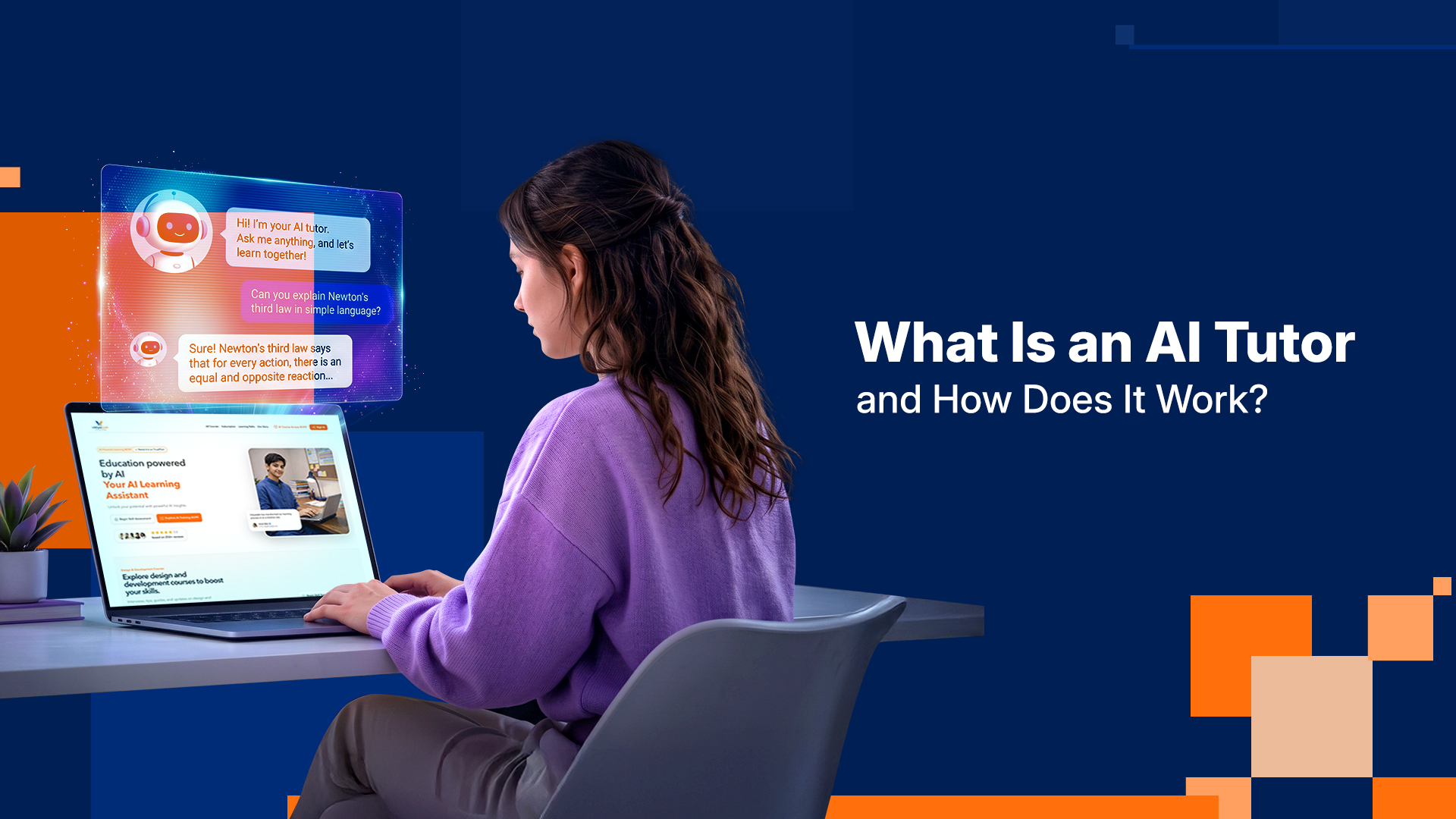
Artificial intelligence is becoming an increasingly important part of modern education. Students can now use AI to ask questions, practise difficult concepts, receive explanations, review mistakes, and explore subjects at their own pace. One of the most notable developments in this area is the AI tutor.
But what exactly is an AI tutor, and how does it differ from a conventional educational platform or a general-purpose chatbot?
An AI tutor is an artificial intelligence-powered learning system designed to provide interactive educational assistance. Depending on the platform, it can explain concepts, answer questions, generate exercises, provide hints, assess responses, identify areas where a learner may need additional practice, and adapt the learning interaction to the student’s needs.
Modern AI tutors commonly combine technologies such as large language models (LLMs), natural language processing (NLP), machine learning, adaptive learning techniques, automated assessment, and educational content.
The important point is that an AI tutor is not simply designed to give an answer. A well-designed tutoring system aims to help a learner understand why an answer is correct and develop the ability to solve similar problems independently.
What Is an AI Tutor?
An AI tutor is an AI-powered educational system that interacts with learners and provides personalized or interactive academic support.
An AI Tutor can explain a difficult concept, answer follow-up questions, provide examples, generate practice activities, give hints, review an answer, and help a learner identify where their reasoning went wrong.
For example, imagine a student is learning mathematics and asks:
“Why is my answer to this equation wrong?”
A basic answer-generation system might simply provide the correct answer.
A tutoring-oriented system can instead identify the step where the student’s calculation went wrong, explain the underlying concept, provide a similar example, and ask the learner to try again.
That distinction is important because effective learning involves more than receiving correct information. Students need opportunities to understand, practise, make mistakes, receive feedback, and apply what they have learned.
How Is an AI Tutor Different From a Regular AI Chatbot?
AI tutors and general-purpose AI chatbots can use similar underlying technologies, but their purposes can be different.
A general AI chatbot is designed to handle a broad range of conversations and tasks. It may answer questions about education, programming, writing, travel, business, or many other subjects.
An AI tutor, by contrast, is designed around learning.
A tutoring system may incorporate:
- Learning objectives
- Educational content
- Guided problem-solving
- Hints
- Practice questions
- Feedback
- Assessment
- Difficulty adjustment
- Learning progress
- Subject-specific instructions
- Safety and age controls
For example, Khan Academy describes Khanmigo as an AI-powered tutor and teaching assistant that guides learners toward solving problems rather than simply giving them direct answers. Its student guidance also recommends using AI as a learning companion rather than as the only source of information.
Therefore, the presence of a conversational AI interface alone does not necessarily make a product an effective AI tutor. Educational design matters just as much as the underlying AI model.
How Does an AI Tutor Work?
The exact architecture differs between platforms, but the basic process can be represented as:
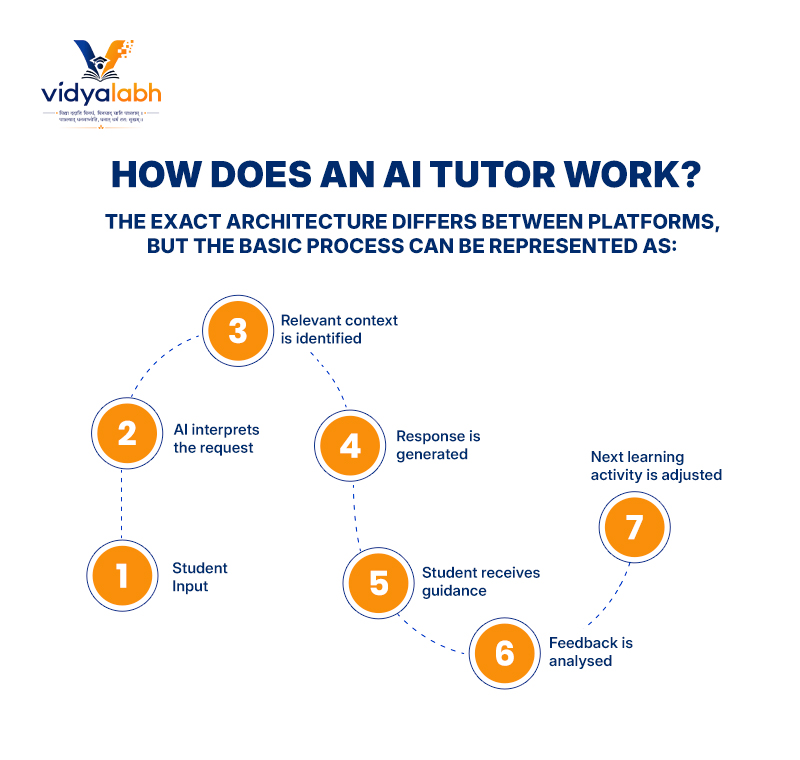
Here is what happens at each stage.
1. The Student Provides a Question or Task
The interaction begins when a learner enters a question, submits an answer, asks for an explanation, provides a piece of code, or starts a learning activity.
For example:
“Explain Newton’s third law in simple language.”
Or:
“Why is my Python code returning this error?”
The AI system receives this input and determines what the learner is trying to accomplish.
2. Natural Language Processing Helps Interpret the Request
Natural language processing allows an AI system to work with human language.
Instead of requiring students to use a rigid command structure, modern AI systems can interpret questions written in everyday language.
The system may try to identify:
- The subject
- The specific concept
- The learner’s question
- The expected type of response
- Relevant previous conversation
- Whether the learner needs an explanation, example, hint, or solution
This makes conversational learning possible.
A student can ask:
“What is a Python variable?”
Then follow with:
“Can you explain it more simply?”
Then:
“Give me an example.”
The learner does not necessarily need to repeat the entire context each time.
3. The AI Model Generates an Educational Response
Many modern AI tutors use large language models to generate natural-language responses.
An LLM is trained to recognize patterns in language and generate responses based on the information and instructions available to it. In educational applications, these models can generate explanations, examples, definitions, questions, and guided problem-solving interactions. However, even educational implementations acknowledge that language models can make mistakes.
This is why an AI tutor needs more than a powerful language model.
The system also needs appropriate educational instructions and safeguards that determine how the model should respond.
For instance, when a student asks for the answer to a mathematics problem, the tutor may be designed to provide a hint first rather than immediately revealing the solution.
4. The System Uses Context
Context allows the AI tutor to make the interaction more relevant to the learner.
Suppose one student understands basic programming but struggles with recursion, while another student is still learning variables and conditional statements.
Both students may ask:
“What is recursion?”
A personalized system could provide different explanations depending on their previous learning activity and demonstrated knowledge.
This is one of the fundamental ideas behind adaptive learning: instructional support can respond to the learner rather than assuming that every learner has the same level of understanding.
However, personalization is not automatically accurate. An AI system can misunderstand a student’s ability level or incorrectly identify the reason they are struggling. Personalization therefore depends on the quality of the system’s assessment and learning design.
5. The AI Provides Feedback
Feedback is one of the most important components of tutoring.
Instead of only telling a student that an answer is wrong, an AI tutor can potentially explain:
- Which part of the answer is incorrect
- Why the mistake occurred
- Which concept needs review
- What the student should reconsider
- What step to attempt next
For example, if a student writes incorrect Python syntax, an AI tutor could identify the relevant syntax problem and explain the rule instead of simply replacing the student’s code.
This can turn an error into a learning opportunity.
6. The System Can Generate Additional Practice
An AI tutor can also generate exercises based on a particular concept.
A student might ask:
“Give me five beginner questions about Python loops.”
The system can create practice questions and, depending on the platform, provide feedback as the learner works through them.
More advanced systems can potentially use previous performance to determine which topics deserve additional practice.
This is particularly useful when a student understands a concept theoretically but needs more opportunities to apply it.
What Technologies Are Used in an AI Tutor?
An AI tutor can combine several technologies rather than relying on one AI model.
Large Language Models
LLMs provide the conversational capabilities that allow an AI tutor to understand and generate natural-language responses.
Natural Language Processing
NLP helps interpret questions, identify intent, process written responses, and maintain conversational context.
Machine Learning
Machine learning can analyse patterns in learner interactions and performance and can support prediction, recommendation, and personalization.
Adaptive Learning
Adaptive learning technology can adjust the difficulty, sequence, or type of learning activity according to a learner’s progress.
Knowledge Retrieval
Some AI systems retrieve information from specific educational materials, documents, databases, or knowledge bases before generating a response.
This approach can help ground answers in defined sources rather than relying entirely on the language model’s general knowledge.
Automated Assessment
AI can evaluate certain types of answers, quizzes, programming exercises, and written responses.
However, automated evaluation has limitations. Complex assignments often require human judgement because quality and correctness cannot always be determined by a simple automated rule.
Conversational Interfaces
Conversational interfaces allow students to ask follow-up questions naturally.
This is particularly useful because learning is rarely a one-question process.
A learner may ask:
“What is photosynthesis?”
followed by:
“Why is sunlight important?”
and then:
“Can you give me a simple example?”
An AI tutor can maintain the conversation around the same learning objective.
How Does AI Personalize Learning?
Personalization is one of the major reasons AI tutoring has attracted attention in education.
In a traditional classroom, one teacher may need to support many students with different levels of knowledge, learning speeds, and difficulties. Teachers can differentiate instruction, but providing an individualized explanation and practice sequence for every student can be challenging.
AI tutoring can potentially provide another layer of individualized support.
A system may use information such as:
- Previous questions
- Quiz results
- Incorrect answers
- Completed lessons
- Practice history
- Current difficulty level
- Learning objectives
- Areas where the learner needs additional practice
For example, a student learning programming may already understand variables and conditional statements but repeatedly make mistakes with loops.
Rather than returning to basic programming concepts, a personalized system could provide more exercises involving loops and debugging.
This does not mean the AI will always make the right decision. The system must have enough reliable information about the learner and a suitable method for interpreting that information.
AI Is Changing Personalized Learning
The ability to combine conversational interaction, adaptive practice, immediate feedback, and learner information demonstrates how AI Is changing personalized learning.
Instead of presenting exactly the same explanation to every learner, AI can allow students to request different forms of support.
For example, a learner can ask for:
- A beginner-level explanation
- A real-world example
- A visual description
- A step-by-step walkthrough
- A practice question
- A harder version of the problem
- A hint without the final answer
This flexibility can make learning more interactive.
The important consideration is that personalization should support learning rather than simply make information easier to obtain.
A student who always receives complete answers may finish assignments faster without necessarily developing deeper understanding.
What Are AI Tutors Used For?
AI tutoring can be applied across many subjects and learning activities.
Mathematics
Students can use AI tutoring to understand formulas, work through equations, identify calculation mistakes, and practise similar problems.
Science
AI can explain scientific concepts, provide examples, create revision questions, and help students break complicated topics into smaller ideas.
Programming
Programming learners can ask for explanations of syntax, debugging assistance, coding exercises, project ideas, and feedback on their code.
For beginners, the ability to learn python with AI can make programming practice more interactive because learners can ask questions while writing and testing their own code.
Languages
AI can support vocabulary practice, grammar explanations, conversational exercises, writing feedback, and pronunciation-related activities where appropriate tools are available.
Writing
AI can help learners brainstorm ideas, understand grammar, organize arguments, and receive feedback on drafts.
Students should still develop their own ideas and understand the final work rather than simply submitting AI-generated content.
Exam Preparation
AI can generate practice questions, explain incorrect answers, create revision exercises, and help students identify topics that need more attention.
How Can AI Tutors Help Students?
The growing use of AI tutors for students reflects a broader shift toward accessible, on-demand learning support.
Students can potentially use AI tutoring to:
- Review difficult topics
- Ask follow-up questions
- Practise outside classroom hours
- Request simpler explanations
- Generate additional exercises
- Review mistakes
- Prepare for examinations
- Learn programming
- Explore unfamiliar subjects
- Receive immediate feedback
One advantage is patience.
A student can ask the same concept to be explained several times without worrying about interrupting a teacher or slowing down a classroom discussion.
However, this should complement rather than replace human educational support.
For younger learners in particular, responsible implementation requires attention to age appropriateness, privacy, safety, and appropriate adult involvement. UNESCO’s guidance on generative AI in education emphasizes a human-centred approach, data privacy, age considerations, and pedagogical validation.
AI Tutor vs Traditional Learning
The question of AI Tutor vs Traditional Learning is more useful when treated as a comparison of different learning resources rather than an assumption that one approach must replace the other.
Traditional education provides several things that AI systems cannot fully reproduce.
Teachers can provide:
- Human mentorship
- Classroom interaction
- Social learning
- Emotional support
- Contextual judgement
- Curriculum guidance
- Collaboration
- Motivation
- Human assessment
AI tutors can provide:
- On-demand explanations
- Repeated explanations
- Immediate feedback
- Personalized practice
- Conversational support
- Additional exercises
- Flexible learning schedules
- Assistance with specific learning difficulties
These capabilities can complement each other.
For example, a teacher may introduce a concept during class, while students use an AI tutor afterward for additional practice or clarification.
This creates a blended learning model in which AI provides additional support without removing the teacher from the learning process.
What Does Research Say About AI Tutors?
Research into AI tutoring is growing, but it is important to distinguish evidence from broad claims about what AI can potentially do.
A 2025 systematic review published in npj Science of Learning examined 28 studies involving 4,597 K–12 students. The review found that AI-driven intelligent tutoring systems generally had positive effects on learning and performance, but those effects were reduced when the systems were compared with other non-intelligent tutoring systems. The researchers also highlighted the need for longer interventions, larger and more diverse samples, and additional investigation into ethical issues.
This is important because it shows that simply calling a system “AI-powered” does not guarantee better learning outcomes.
The educational design matters.
Researchers need to consider questions such as:
- Does the system encourage active learning?
- Does it provide useful feedback?
- Does it adapt appropriately?
- Does it improve understanding rather than merely task completion?
- How long does the effect last?
- How does it compare with existing educational support?
- How does it affect different groups of learners?
Consequently, claims about AI tutoring should be based on evidence from specific systems and learning environments rather than assuming that every AI tutor will produce identical results.
Why Educational Design Matters
A sophisticated AI model alone does not automatically create an effective tutor.
An AI tutoring system should ideally be designed around clear educational objectives.
Clear Learning Goals
The system should know what students are expected to understand or achieve.
Guided Learning
Instead of immediately providing solutions, the system can encourage students to think through problems.
Meaningful Practice
Students need opportunities to apply what they have learned.
Useful Feedback
Feedback should explain mistakes rather than merely identify them.
Appropriate Difficulty
Exercises that are far too easy or difficult may not provide useful practice.
Assessment
The system needs ways to determine whether students actually understand the topic.
Reliable Content
Educational explanations should be based on accurate information.
Human Oversight
Teachers and other qualified educators remain important, particularly when students require complex guidance.
Khan Academy’s current approach to Khanmigo illustrates this emphasis on guided learning: its platform describes the tutor as helping students think critically and solve problems rather than simply supplying direct answers.
What Are the Limitations of AI Tutors?
AI tutoring has significant potential, but it also has limitations that students and educators should understand.
AI Can Provide Incorrect Information
Large language models can produce inaccurate facts, flawed reasoning, or misleading explanations.
An AI-generated response should therefore not automatically be treated as authoritative.
For important academic or technical information, students should verify claims using textbooks, official documentation, academic sources, teachers, or other reliable resources.
AI Can Misunderstand the Student
A learner may ask a question that appears simple but is actually caused by a deeper misunderstanding.
An AI tutor may not always identify that underlying issue correctly.
Personalization Can Be Imperfect
An AI system may incorrectly estimate a learner’s level or recommend an inappropriate activity.
Personalization is only as effective as the data, assessment methods, and educational logic behind it.
Students Can Become Overdependent
One of the biggest risks is using AI as an answer machine.
If a student consistently asks AI to complete homework, write code, solve equations, or produce essays without attempting the work independently, the technology can reduce opportunities for practice.
Privacy Matters
AI learning systems may process questions, assignments, conversations, performance information, and other learner data.
Students, parents, teachers, and institutions should understand what information a platform collects and how it is handled.
UNESCO’s guidance specifically identifies privacy protection and age-appropriate use as important elements of responsible AI adoption in education.
Human Teaching Remains Important
AI can provide explanations and feedback, but teaching involves relationships, mentorship, social interaction, classroom management, motivation, and contextual judgement.
These are not simply technical functions that can be reduced to automated responses.
How Should Students Use an AI Tutor Effectively?
The way students use AI can significantly affect its educational value.
A useful approach is:
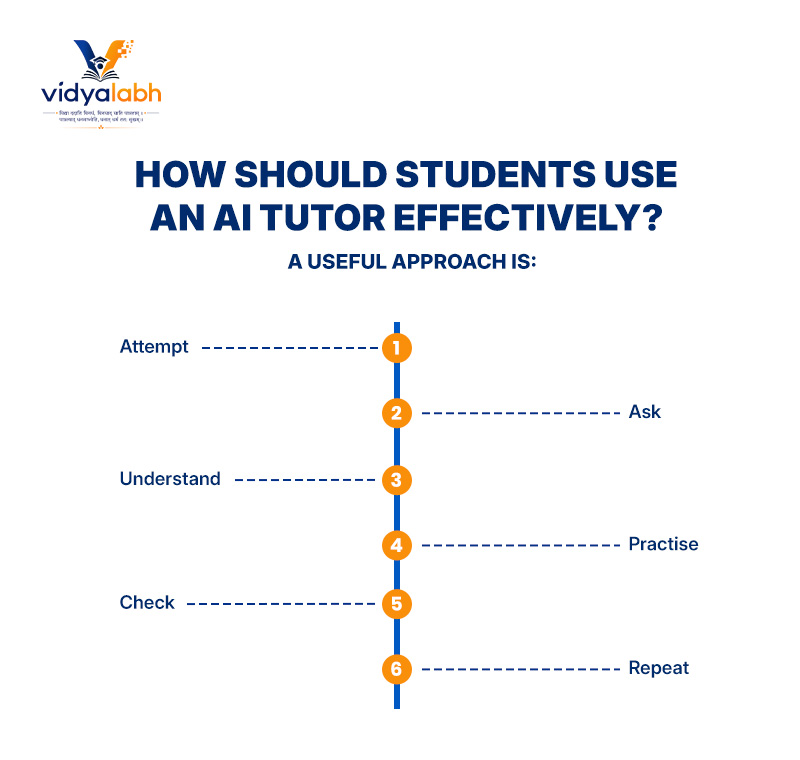
1. Attempt the Problem First
Try to solve the question yourself before asking AI.
2. Ask for a Hint
If you are stuck, ask for a clue instead of requesting the complete solution.
3. Understand the Explanation
If the first explanation is confusing, ask the tutor to explain the concept using simpler language or a different example.
4. Solve the Problem Yourself
After receiving guidance, attempt the problem independently.
5. Request Feedback
Submit your answer and ask the AI to identify mistakes and explain why they occurred.
6. Practise a Similar Problem
Ask for another question that tests the same concept.
7. Test Yourself Without AI
Finally, solve a similar problem without assistance.
This approach makes AI part of the learning process rather than a replacement for the learner’s own thinking.
Example: Using an AI Tutor to Learn Python
Consider a beginner learning Python.
The student starts by asking:
“What is a Python variable?”
The AI tutor explains the concept.
The student then asks:
“Can you give me a simple example?”
After understanding the example, the student asks:
“Give me a practice question, but don’t give me the answer.”
The AI generates an exercise.
The student writes the code and runs it.
If an error appears, the learner can ask:
“Explain what is wrong with my code, but don’t rewrite the whole program.”
The AI can then provide guidance.
The learner fixes the problem and attempts another exercise.
This creates a learning loop:
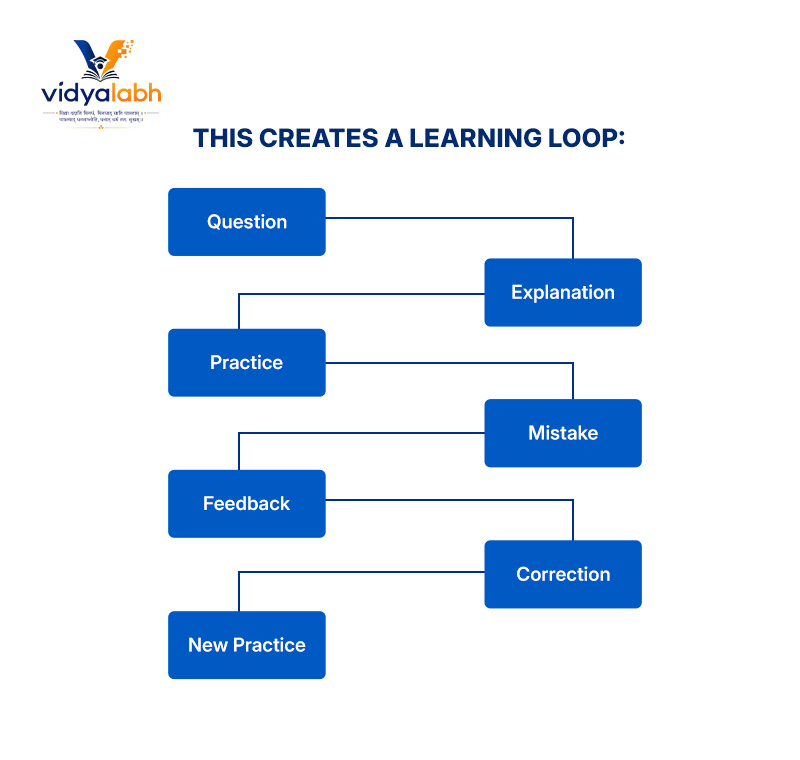
That is considerably different from asking AI to generate an entire program and copying it without understanding the code.
Can AI Tutors Replace Teachers?
AI tutors can support several activities traditionally performed by educational resources or tutors, but they do not replace the full role of a teacher.
A teacher can understand classroom dynamics, identify individual concerns, provide mentorship, manage group activities, encourage collaboration, assess complex work, and make contextual educational decisions.
An AI tutor can provide repeated explanations, practice activities, feedback, and on-demand support.
Therefore, a more practical way to view the relationship is:
Teacher: human guidance, mentorship, structure, and educational judgement
AI tutor: personalized assistance, explanations, practice, and feedback
Student: active participation, critical thinking, and independent problem-solving
This model allows AI to extend learning opportunities without assuming that technology can reproduce every part of human teaching.
How to Choose an AI Tutor
Students, parents, and educators should evaluate an AI learning platform based on its educational capabilities rather than simply its AI branding.
Important questions include:
Does It Support Learning Rather Than Just Answers?
A good learning system should help students understand concepts rather than simply complete tasks.
Does It Provide Feedback?
Look for systems that explain mistakes and provide useful guidance.
Can It Adapt to the Learner?
Personalization may include difficulty adjustment, practice recommendations, or different explanation styles.
Does It Provide Practice?
Learning requires application. An effective platform should give students opportunities to practise.
Is the Information Reliable?
Students should be able to verify important information and understand that AI can make mistakes.
Does It Protect Student Data?
Privacy policies, age requirements, parental controls, and data practices are particularly important when children use AI systems.
Does It Complement Human Education?
The most useful AI learning systems can fit into a broader learning environment rather than encouraging students to rely exclusively on AI.
What Is the Future of AI Tutoring?
AI tutoring is developing beyond simple conversational question answering.
Emerging educational applications include:
- Adaptive learning paths
- AI-generated practice questions
- Diagnostic assessments
- Personalized revision
- Guided problem solving
- Coding assistance
- Interactive quizzes
- Multimodal learning
- Progress analysis
- Personalized study support
The direction of development is increasingly focused on making AI more responsive to the learner’s context.
Instead of simply asking:
“What answer should I give?”
an educational AI system needs to consider:
“What does this learner already understand?”
“What are they struggling with?”
“What kind of explanation would help?”
“Should I provide the answer or a hint?”
“What should they practise next?”
These questions move AI tutoring closer to the principles of adaptive education.
Khan Academy, for example, describes its ongoing development of Khanmigo as an iterative process involving classroom observations, student and teacher interviews, and analysis of student interactions.
This type of evaluation is important because AI education tools should be assessed not only by how impressive their responses sound, but also by whether they actually support learning.
Frequently Asked Questions About AI Tutors
What is an AI tutor?
An AI tutor is an artificial intelligence-powered learning system that provides educational assistance through explanations, questions, practice, feedback, and, in some systems, personalized learning activities.
How does an AI tutor work?
An AI tutor typically interprets a learner’s question using technologies such as natural language processing and large language models, considers relevant context, generates an educational response, and may use learner performance or interaction history to adjust future support.
What is the difference between an AI tutor and an AI chatbot?
A general AI chatbot can answer educational questions, while an AI tutor is specifically designed around learning objectives and may provide guided problem solving, practice, feedback, assessment, and personalized support.
Can AI tutors personalize learning?
Yes. AI tutors can potentially adapt explanations, exercises, feedback, and difficulty according to a learner’s questions and performance. However, the accuracy of personalization depends on the quality of the system’s data and educational design.
Are AI tutors useful for students?
AI tutors can support students with explanations, revision, practice, feedback, programming, and other learning activities. Their effectiveness depends on the particular system, subject, learning environment, and way the technology is used.
Can an AI tutor replace a teacher?
AI tutors can support certain teaching and learning tasks, but they do not replace the full role of teachers, including mentorship, social learning, classroom interaction, emotional support, and complex educational judgement.
Can beginners use AI tutors?
Yes. Beginners can use AI tutors to request simple explanations, examples, hints, exercises, and feedback. They should still use reliable educational resources and human guidance where appropriate.
Can AI tutors help students learn programming?
Yes. AI tutors can explain programming concepts, identify potential coding errors, provide hints, generate exercises, and support debugging. Students should write, run, test, and understand their own code rather than simply copying generated solutions.
Are AI tutor answers always correct?
No. AI systems can generate incorrect information or reasoning. Important information should be checked against reliable sources, particularly when it affects academic work.
How can students avoid becoming dependent on AI?
Students can attempt problems independently, ask for hints instead of complete answers, solve similar problems without AI, explain concepts in their own words, and regularly practise without assistance.
What makes an AI tutor effective?
An effective AI tutor requires more than a capable language model. Educational objectives, accurate content, appropriate instructional strategies, meaningful practice, useful feedback, assessment, personalization, privacy safeguards, and active student participation all contribute to the quality of the learning experience.
Final Thoughts
An AI tutor is best understood as an interactive learning system rather than simply an AI chatbot.
It can explain concepts, answer questions, generate practice activities, provide feedback, and potentially adapt learning support to individual needs. These capabilities are changing how students can access educational assistance outside traditional classroom settings.
Research into intelligent tutoring systems provides evidence that AI-supported tutoring can improve learning outcomes in some contexts, but the evidence also shows why broad claims should be treated carefully. A 2025 systematic review of 28 K–12 studies involving 4,597 students found generally positive effects from AI-driven intelligent tutoring systems, while also noting that the advantages were less pronounced compared with other intelligent or non-AI tutoring approaches and that more research is needed.
The technology therefore should not be viewed simply as a replacement for teachers or traditional education.
Its greatest educational value may come from combining AI assistance with human teaching and active student participation.
A student can learn from a teacher, practise with an AI tutor, verify information through reliable resources, and develop independent problem-solving skills through repeated practice.
The goal is not for AI to do the learning for the student.
The goal is to make learning more interactive, accessible, responsive, and personalized while keeping the learner at the centre of the process.