AI Tutor vs Traditional Learning: Which Is Better for Students in 2026?
 By Ayan Sarkar
19 min read
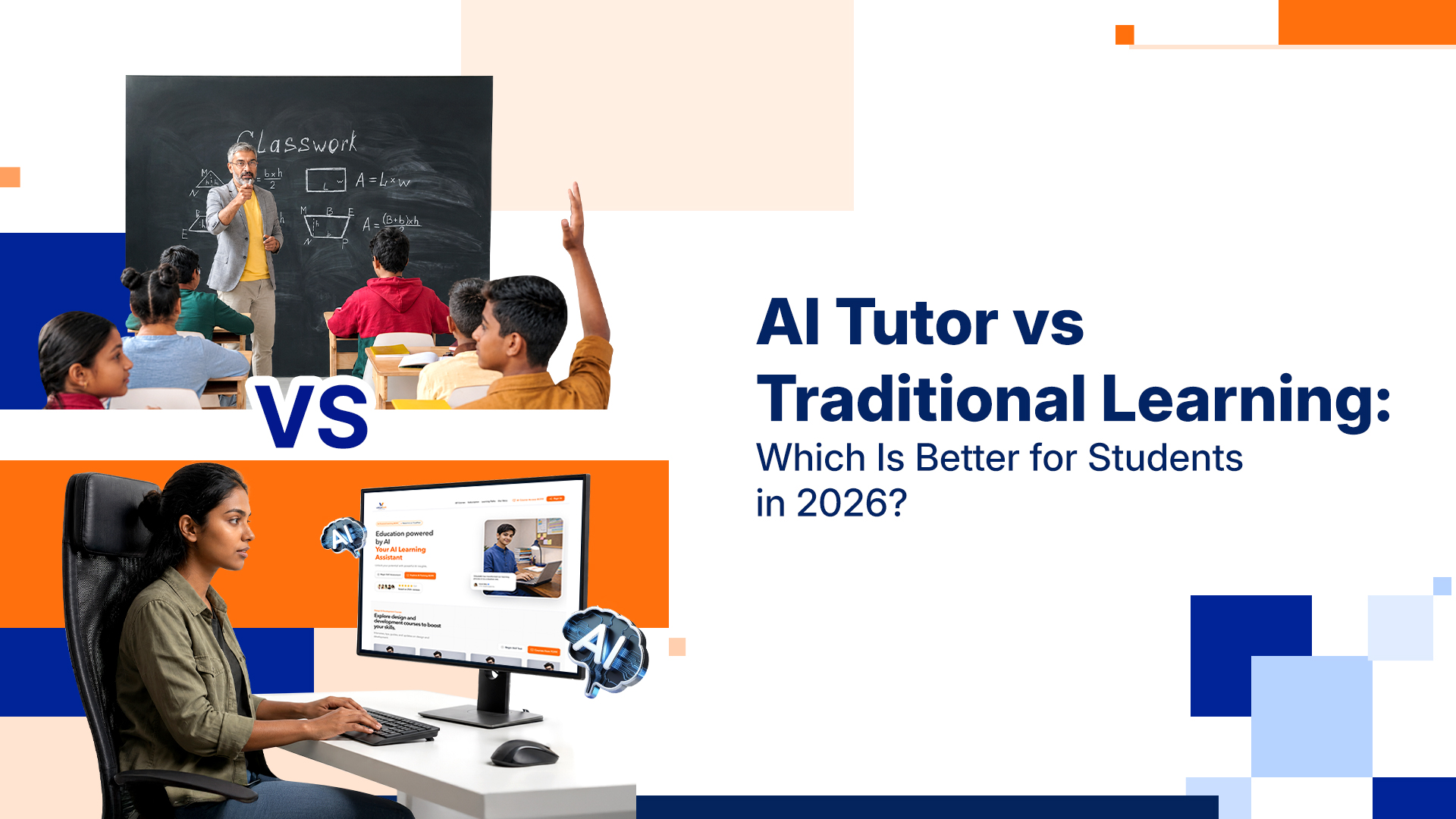
What Is an AI Tutor?
An AI tutor is an artificial intelligence-powered learning system designed to help students understand subjects, practice skills, ask questions, and receive feedback.
Unlike a conventional learning platform that primarily delivers pre-created lessons, an AI tutor can interact with students conversationally. Depending on the system, it may answer questions, explain concepts in different ways, generate exercises, provide hints, evaluate responses, and adapt its assistance based on a student’s interactions.
A personal AI tutor takes this approach further by providing a more individualized learning experience.
For example, a student learning Python might ask:
“Why does my loop keep returning the wrong result?”
An AI tutor may analyze the student’s code, identify a potential problem, explain the underlying concept, and generate another exercise to reinforce the skill.
Technologies Used by AI Tutors
Modern AI tutors may use technologies such as:
- Large language models (LLMs)
- Natural language processing (NLP)
- Machine learning
- Knowledge retrieval
- Adaptive learning systems
- Automated assessment
- Conversational AI
However, adding AI to an educational product does not automatically make it an effective tutor. The quality of instructional design, feedback, curriculum alignment, and student interaction also affects the learning experience.
What Is Traditional Learning?
Traditional learning generally refers to education delivered through established methods such as classrooms, teachers, textbooks, assignments, lectures, structured courses, and human tutoring.
It can include:
- Classroom instruction
- One-to-one tutoring
- Lectures
- Textbooks
- Homework
- Group discussions
- Practical activities
- Teacher-led assessments
- Structured online courses
The defining characteristic is usually the involvement of a human educator who can interpret student context and make instructional decisions.
Teachers do more than communicate information. They can recognize when students are confused, change their teaching approach, provide encouragement, evaluate complex work, manage classroom interaction, and offer mentorship.
These human elements remain important even as AI becomes increasingly common in education.
AI Tutor vs Traditional Learning: What Is the Difference?
The biggest difference is how instruction is delivered, personalized, and supported.
Traditional learning generally follows a defined curriculum delivered by a teacher or instructor. Students often learn according to a shared schedule and structure.
An AI tutor provides conversational, on-demand assistance that can respond to an individual student’s questions and interactions.
| Learning Factor | AI Tutor | Traditional Learning |
| Personalization | High potential | Moderate to high |
| Availability | Often available on demand | Based on schedule |
| Feedback | Usually immediate | Often delayed |
| Learning pace | Flexible | Usually structured |
| Human interaction | Limited | High |
| Social learning | Limited | Strong |
| Mentorship | Limited | Strong |
| Practice generation | Automated | Usually teacher-created |
| Accessibility | Potentially high | Depends on resources |
| Accountability | Depends on student and system | Often stronger |
| Emotional support | Limited | Stronger |
| Scalability | High | More limited |
| Independent learning | Strong | Moderate to strong |
| Risk of incorrect information | Possible | Possible |
| Collaboration | Limited | Strong |
| Structured curriculum | Depends on system | Strong |
Neither approach is universally superior. Each addresses different learning needs.
Is an AI Tutor Better Than Traditional Learning?
An AI tutor can be better for certain learning tasks, while traditional learning remains stronger for other educational needs.
An AI tutor can be particularly useful when students need:
- Immediate answers to questions
- Repeated explanations
- Personalized practice
- Flexible learning schedules
- Additional exercises
- Instant feedback
- Individualized learning support
Traditional learning can be more effective when students need:
- Human mentorship
- Emotional support
- Classroom interaction
- Collaboration
- Structured progression
- Complex judgment
- Social development
- Teacher supervision
The more useful question is therefore not simply whether AI is better than traditional learning. It is which learning method is better for a particular student, task, and context.
How Does a Personal AI Tutor Personalize Learning?
A personal AI tutor can personalize learning by responding to a student’s questions, performance, mistakes, and learning pace.
Consider two students learning the same programming concept.
Student A understands variables and functions but struggles with recursion.
Student B is still struggling with variables and conditional statements.
A conventional classroom may introduce both students to the same lesson at the same time. An AI tutor can potentially provide different explanations and exercises based on each student’s current needs.
How Adaptive Learning Works in Practice
One student may receive:
- Advanced explanations
- Recursion examples
- Debugging exercises
- Progressively more difficult problems
The other student may receive:
- Foundational explanations
- Simpler examples
- Variable and conditional exercises
- Additional practice with core programming concepts
The student can then use feedback to identify areas that need more attention and continue practicing.
This is the basic idea behind adaptive learning: the learning experience changes according to the student’s current level of understanding rather than providing exactly the same instruction to everyone.
However, personalization does not automatically mean better learning. An AI system can personalize the wrong material, misunderstand a student’s difficulty, or provide an inaccurate explanation.
Effective personalization therefore requires both good technology and sound pedagogy.
Is an AI Tutor More Personalized Than a Classroom?
An AI tutor can provide more individualized interaction than a classroom because it can respond to one student’s questions and performance at a time.
A classroom teacher may be responsible for supporting dozens of students simultaneously. Even an experienced teacher has limited time to:
- Answer every question individually
- Review every mistake immediately
- Create customized exercises for every student
- Adjust the difficulty of every activity
- Repeat explanations as many times as needed
An AI tutor can potentially provide this type of individual interaction at scale.
However, the distinction is important: more personalization does not automatically produce better educational outcomes.
The quality of the content, instructional method, feedback, assessment, and student participation still matters.
What Are the Advantages of an AI Tutor?
Immediate Feedback
One of the biggest advantages of an AI tutor is the speed of feedback.
A student can ask a question and receive a response immediately. In traditional learning, feedback may come later after an assignment is reviewed or during a subsequent class.
Immediate feedback can help students identify mistakes while the underlying concept is still fresh.
Learning at Your Own Pace
Students do not all learn at the same speed.
A personal AI tutor can allow students to:
- Repeat explanations
- Ask follow-up questions
- Request simpler examples
- Increase difficulty
- Practice additional questions
- Review previous concepts
This can make learning more flexible.
On-Demand Learning Support
An AI tutor can potentially provide assistance outside conventional schedules.
Students studying at night, on weekends, or during holidays can access AI-based support when they need it.
This can be particularly useful for independent learners.
Additional Practice
Practice is an essential part of learning.
Students studying mathematics, programming, languages, science, or other subjects can ask an AI tutor to generate additional exercises.
For example:
“Give me five Python exercises on loops, starting at beginner level and gradually increasing in difficulty.”
The student can attempt the problems and request hints when needed.
Private Questioning
Some students hesitate to ask questions in front of classmates because they are concerned about making mistakes.
An AI tutor can provide a private conversational environment where students can ask basic questions repeatedly.
This may make it easier for some learners to identify and address knowledge gaps.
Adaptable Explanations
Students do not all understand concepts in the same way.
One student may prefer examples. Another may prefer an analogy. Another may need a step-by-step explanation.
An AI tutor can potentially generate different explanations based on the student’s request.
For example:
“Explain recursion like I’m a beginner.”
The student can then ask:
“Now explain it using a real-world analogy.”
And finally:
“Show me a simple Python example.”
This conversational approach can supplement classroom instruction and independent study.
What Are the Disadvantages of an AI Tutor?
AI Can Provide Incorrect Information
AI systems can generate inaccurate information, flawed reasoning, or misleading explanations.
This matters particularly when students are learning technical, scientific, mathematical, or factual subjects.
Students should therefore avoid assuming that every AI-generated response is correct. Important information should be verified using reliable sources or qualified educators.
Students Can Become Overdependent
One of the biggest risks is using AI to avoid thinking.
There is a major difference between:
“Help me understand this problem.”
and:
“Give me the answer.”
If students consistently use AI to complete assignments, they may produce correct answers without developing the underlying skill.
An AI tutor should therefore support learning rather than simply accelerate task completion.
Limited Human Understanding
AI can analyze language and interaction patterns, but it does not reproduce the complete human teaching relationship.
A teacher may recognize that a student is:
- Losing confidence
- Becoming frustrated
- Losing motivation
- Struggling with a foundational concept
- Becoming disengaged
Human educators can respond to these situations using experience, context, and personal judgment.
Privacy Concerns
AI tutoring systems may process information about students’ questions, activities, learning progress, or performance.
Privacy therefore becomes an important consideration.
Students, parents, schools, and education providers should understand:
- What information is collected
- Why it is collected
- How long it is retained
- Who can access it
- Whether it is used for model training
- What privacy controls are available
Responsible AI adoption in education requires attention to both learning outcomes and data protection.
What Are the Advantages of Traditional Learning?
Traditional education continues to offer advantages that AI tutoring cannot fully reproduce.
Human Mentorship
Teachers can guide students beyond the immediate academic problem.
They can help students understand how a subject connects to careers, real-world challenges, and personal development.
Social Interaction
Classrooms provide opportunities for students to:
- Discuss ideas
- Work in teams
- Present projects
- Debate
- Collaborate
- Learn from peers
These experiences develop interpersonal and communication skills that individual AI tutoring does not naturally provide.
Structured Learning
Traditional education typically provides:
- A defined curriculum
- Learning objectives
- Deadlines
- Assessments
- Progression
- Accountability
This structure can be especially valuable for students who struggle with self-directed learning.
Emotional Support
Teachers can provide encouragement and recognize when students need additional support.
The human relationship between educator and student remains an important component of education.
Is Traditional Learning Still Relevant in 2026?
Yes. Traditional learning remains relevant because education involves more than delivering information.
AI can make information and personalized assistance more accessible, but students still need opportunities to develop:
- Communication
- Collaboration
- Critical thinking
- Creativity
- Problem-solving
- Leadership
- Social skills
- Independent judgment
Schools, universities, training organizations, and teachers can use AI to enhance learning without removing the human elements of education.
The question is increasingly becoming how AI should be integrated into education rather than whether AI should be used at all.
Does AI Tutoring Improve Student Learning?
Research suggests that well-designed AI tutoring can improve learning outcomes, but results depend on how the technology is designed and used.
A 2025 randomized controlled trial published in Scientific Reports compared a research-designed AI tutor with active-learning classroom instruction among 194 undergraduate physics students. The researchers reported significantly greater learning gains for students using the AI tutor, while also reporting higher engagement and motivation and less time spent learning.
A separate 2025 systematic review of AI-driven intelligent tutoring systems in K–12 education examined 28 studies involving 4,597 students. The review generally found positive effects on learning and performance, while noting that the benefits were less pronounced when intelligent tutoring systems were compared with other non-intelligent tutoring approaches. The researchers also highlighted the need for longer interventions, more diverse samples, and further research into ethical considerations.
These findings support an important distinction:
AI access alone does not guarantee better learning.
An AI system that simply provides answers may encourage task completion. An AI tutor designed to provide hints, questions, explanations, feedback, and guided practice can better support active learning.
What Does Research Mean for Students?
The research does not mean that every AI tutor will outperform every teacher or classroom.
Instead, it suggests that well-designed AI tutoring can be an effective learning intervention under appropriate conditions.
Students should therefore evaluate an AI tutor based on factors such as:
- Whether it encourages active participation
- Whether it provides explanations rather than only answers
- Whether feedback is accurate
- Whether practice is aligned with learning objectives
- Whether students are assessed without AI assistance
- Whether the system protects student data
Can AI Tutors Replace Teachers?
AI tutors are unlikely to completely replace teachers because teaching involves instructional, social, emotional, and mentoring responsibilities.
Teachers can:
- Design learning experiences
- Understand student context
- Provide mentorship
- Manage classrooms
- Evaluate nuanced work
- Encourage students
- Facilitate collaboration
- Identify learning difficulties
- Connect education with real-world experiences
AI can assist with many instructional tasks, but education is not simply an information-delivery process.
A more realistic model is:
Teacher = human guidance and educational leadership
AI tutor = personalized learning support
Student = active learner
This division allows each component to contribute what it does best.
Can Students Learn Independently With an AI Tutor?
Yes. Students can use an AI tutor to support independent learning, provided they remain actively involved in the learning process.
A student can use AI to:
- Understand a new concept.
- Ask questions.
- Request examples.
- Practice skills.
- Receive hints.
- Identify mistakes.
- Review difficult topics.
- Generate additional exercises.
- Test their knowledge.
- Explain the topic independently.
However, independent learning should not become AI-dependent learning.
Students still need to think, solve problems, evaluate information, and demonstrate knowledge without assistance.
How Should Students Use an AI Tutor Effectively?
The way students interact with AI can significantly affect the learning experience.
Instead of asking:
“Solve this math problem.”
A student could ask:
“Help me understand how to approach this problem. Give me a hint, but don’t provide the final answer.”
After attempting it, the student could ask:
“Check my reasoning and tell me where I went wrong.”
Then:
“Give me another problem that tests the same concept.”
Finally:
“Ask me three questions to check whether I understand the concept.”
This approach keeps the student actively involved.
A Practical AI Learning Method
Step 1: Try Independently
Attempt the problem before asking AI for help.
Step 2: Ask for Guidance
Request a hint or explanation instead of the final answer.
Step 3: Solve Again
Use the guidance to complete the problem yourself.
Step 4: Check Your Reasoning
Ask the AI tutor to identify potential errors or misconceptions.
Step 5: Practice
Solve a similar problem without copying the previous solution.
Step 6: Explain
Describe the concept in your own words.
Step 7: Test Without AI
Complete a final exercise without assistance.
This approach turns AI from an answer generator into a learning assistant.
AI Tutor vs Human Tutor: Which Is Better?
An AI tutor and a human tutor serve different purposes.
| Area | AI Tutor | Human Tutor |
| Instant answers | Excellent | Limited by availability |
| Personalized explanations | Strong | Strong |
| Emotional understanding | Limited | Strong |
| Practice generation | Strong | Moderate |
| Mentorship | Limited | Strong |
| Flexibility | High | Moderate |
| Accountability | Moderate | Strong |
| Social interaction | Limited | Strong |
| Scalability | High | Limited |
| Contextual judgment | Limited | Strong |
| Repetition | High | Limited by time |
| Complex personal guidance | Limited | Strong |
For practice, revision, and personalized assistance, AI can be extremely useful.
For mentorship, motivation, emotional support, and complex educational guidance, human tutors retain significant advantages.
Which Is Better for Different Types of Students?
Different students can benefit from different approaches.
Students Who Need Flexible Learning
A personal AI tutor can be useful for students who cannot follow a fixed schedule.
Students Who Need Additional Practice
AI can generate additional exercises quickly, making it useful for repetitive practice and revision.
Students Who Need Human Motivation
Traditional teachers and tutors can provide stronger accountability, encouragement, and contextual guidance.
Students Who Learn Socially
Classroom learning can be more effective for students who benefit from discussion, teamwork, and collaboration.
Advanced Learners
AI tutors can help advanced students explore concepts beyond the standard curriculum and ask highly specific questions.
Beginners
Beginners can benefit from both approaches. Human teachers can provide foundational structure, while AI can provide additional explanations and practice.
What Is the Best Combination of AI and Traditional Learning?
For many students, a hybrid learning approach may provide a stronger overall learning experience.
| Learning Component | Primary Role |
| Teacher or classroom | Curriculum, structure, assessment, mentorship, collaboration |
| AI tutor | Personalized explanations, practice, feedback, revision |
| Student | Independent thinking, application, problem-solving, evaluation |
The goal is not to make AI responsible for the entire learning process.
Instead, AI can support the parts of learning where personalization, repetition, immediate feedback, and on-demand assistance are useful, while educators remain responsible for human-centered teaching and students remain responsible for actively learning.
What Skills Should Students Develop Alongside AI?
As AI becomes more capable, students should not focus only on learning how to use AI tools.
They should also learn how to evaluate AI-generated information.
Critical Thinking
Students should question whether an AI-generated response is accurate and logically sound.
AI Literacy
Students should understand the basic capabilities and limitations of AI systems.
Information Verification
Students should learn how to validate important information using reliable sources.
Problem-Solving
Students should be able to approach problems without immediately asking AI for the solution.
Communication
Students still need to explain ideas clearly to teachers, peers, colleagues, and other people.
Creativity
Students should use AI to support creativity rather than allowing it to completely replace their own ideas.
These skills become increasingly important as AI becomes integrated into education and professional environments.
What Will Student Learning Look Like in 2026 and Beyond?
Education is unlikely to become completely AI-driven.
Instead, learning is likely to become increasingly technology-assisted and personalized.
AI can support tasks such as:
- Generating practice questions
- Providing explanations
- Supporting revision
- Giving immediate feedback
- Identifying potential learning gaps
- Adjusting difficulty
- Providing conversational assistance
Teachers can continue focusing on:
- Instructional strategy
- Mentorship
- Classroom interaction
- Assessment
- Collaboration
- Emotional support
- Complex learning challenges
This division could allow educators to spend more time on human-centered aspects of education while AI handles some repetitive support tasks.
However, successful implementation requires careful design. AI should not be added to education simply because it is technologically available. It should be used where it genuinely improves the learning experience.
AI Tutor vs Traditional Learning: Which One Should Students Choose?
Students should choose based on their learning needs rather than treating AI tutoring and traditional learning as competing alternatives.
| Student Need | Better-Suited Approach |
| Flexible study | AI tutor |
| Immediate feedback | AI tutor |
| Personalized practice | AI tutor |
| Repeated explanations | AI tutor |
| Human mentorship | Traditional learning |
| Collaboration | Traditional learning |
| Structured education | Traditional learning |
| Emotional support | Human educators |
| Social learning | Traditional learning |
| Independent practice | AI tutor |
| Complex educational guidance | Human educator |
For many students, combining the two approaches makes the most sense.
Frequently Asked Questions About AI Tutors and Traditional Learning
Is an AI tutor better than traditional learning?
An AI tutor is better suited to certain tasks, including personalized practice, immediate feedback, flexible learning, and on-demand explanations. Traditional learning remains stronger for mentorship, collaboration, emotional support, structure, and social development. Combining both approaches can provide a more complete learning experience.
What Is a Personal AI Tutor?
A personal AI tutor is an AI-powered learning assistant that provides individualized explanations, practice, feedback, and guidance based on a student’s questions, learning needs, and interactions.
Can AI Tutors Replace Teachers?
No. AI tutors can support teachers and automate certain learning tasks, but they cannot fully replace the human judgment, mentorship, emotional support, classroom management, and social interaction provided by teachers.
Do AI Tutors Improve Student Performance?
Research suggests that well-designed AI tutoring systems can improve student learning outcomes. However, results depend on the design of the system and how students use it. AI that encourages active learning can be more educationally valuable than AI that simply supplies answers.
What Are the Benefits of an AI Tutor?
The main benefits include personalized learning, immediate feedback, flexible schedules, additional practice, conversational explanations, accessibility, and on-demand learning support.
What Are the Disadvantages of AI Tutors?
Potential disadvantages include inaccurate information, student overdependence, reduced independent thinking, privacy concerns, limited emotional understanding, and the possibility of using AI to complete work rather than learn.
Can Students Use AI Tutors for Self-Learning?
Yes. Students can use AI tutors to learn concepts, practice skills, receive feedback, review difficult topics, and test their knowledge. They should still attempt problems independently and verify important information.
Is Traditional Learning Still Useful in 2026?
Yes. Traditional learning remains valuable because it provides human instruction, mentorship, structure, collaboration, social interaction, and emotional support.
What Is the Difference Between an AI Tutor and a Human Tutor?
An AI tutor provides automated, on-demand, personalized learning assistance, while a human tutor provides personalized instruction combined with human judgment, mentorship, emotional support, and contextual understanding.
How Accurate Are AI Tutors?
AI tutors are not guaranteed to be accurate. They can produce incorrect facts, flawed reasoning, or misleading explanations. Students should verify important information using reliable sources, textbooks, academic materials, or qualified educators.
Can AI Tutors Identify Learning Gaps?
AI tutors may identify potential learning gaps by analyzing responses, mistakes, questions, and performance patterns. However, the accuracy of these assessments depends on the system’s design, the quality of the data available, and the complexity of the learning problem.
Are AI Tutors Safe for Students?
AI tutor safety depends on factors such as data privacy, age-appropriate design, content safeguards, transparency, accuracy, and how student information is handled. Students and educators should review the privacy and safety practices of any AI tutoring system before using it.
Can AI Tutors Help Beginners?
Yes. A personal AI tutor can explain foundational concepts, answer basic questions, provide examples, and adapt explanations to a beginner’s level. Beginners can still benefit from structured instruction and human guidance when available.
Can AI Tutors Help Advanced Students?
Yes. Advanced students can use AI tutors to explore complex topics, generate challenging exercises, review technical concepts, debug problems, and receive alternative explanations.
How Can Students Avoid Becoming Dependent on AI?
Students can reduce dependence by attempting problems before asking AI for help, requesting hints instead of complete answers, solving similar problems independently, explaining concepts in their own words, and regularly testing themselves without AI assistance.
Conclusion: AI Tutor or Traditional Learning?
There is no universal winner between AI tutoring and traditional learning.
A personal AI tutor changes what personalized learning can look like. Students can receive explanations, practice, feedback, and support when they need it. This makes AI particularly valuable for independent study, revision, reinforcement, and additional practice.
Traditional education offers something different.
Teachers provide human judgment, mentorship, structure, collaboration, motivation, social interaction, and emotional support. These elements remain fundamental to effective education.
For students in 2026, the strongest approach may therefore be neither AI-only nor traditional-only.
It is a balanced combination:
Human guidance + AI personalization + active student participation.
AI should help students learn more effectively—not think less.
The ultimate measure of an AI tutor should not be how quickly it produces an answer. It should be whether the student can eventually solve the problem without needing the AI.