AI Tutor vs Online Courses: Which Is Better for Learning?
 By Ayan Sarkar
18 min read
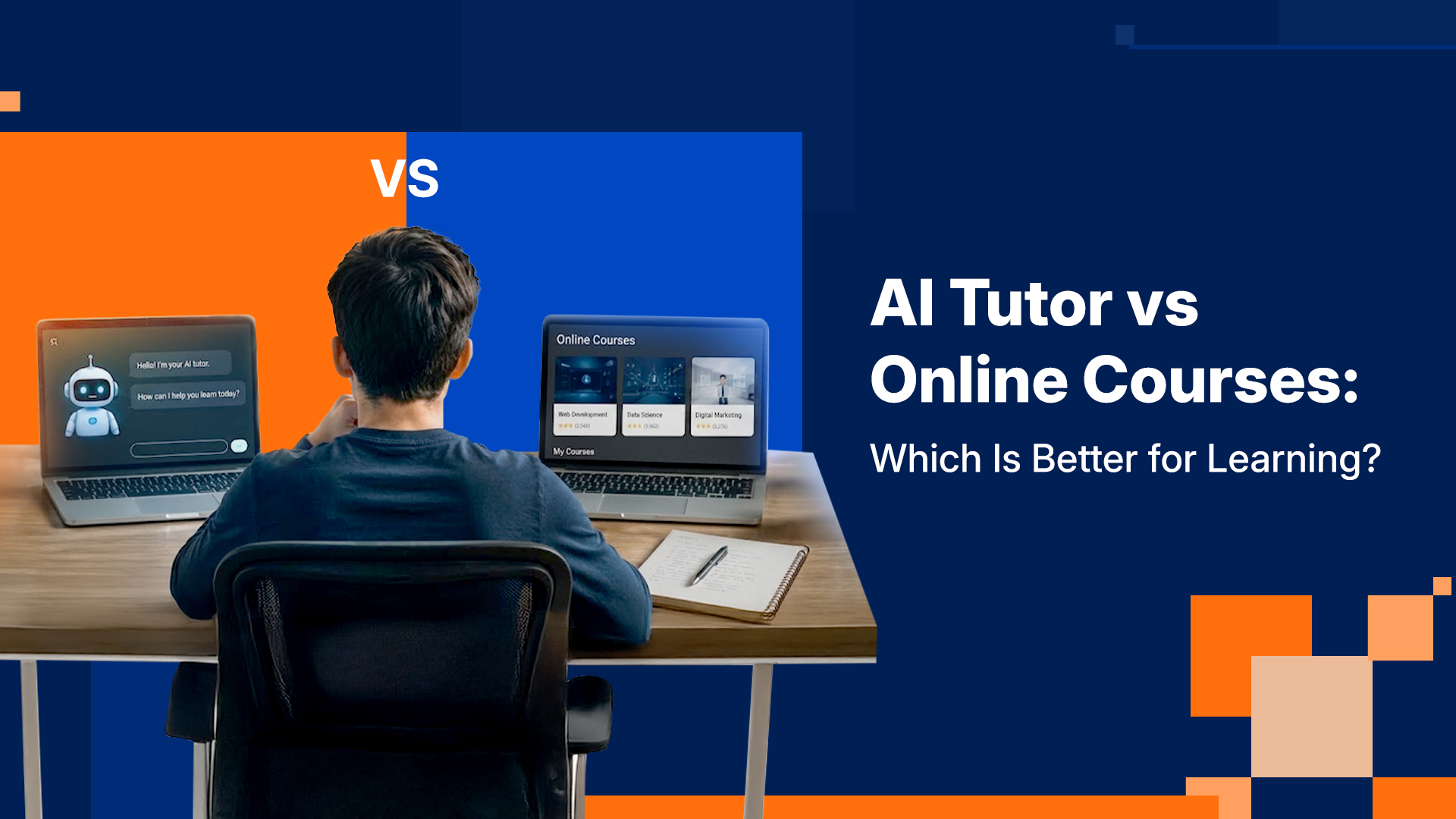
Choosing how to learn has changed significantly with the rise of artificial intelligence. Traditional online courses provide structured lessons, videos, assignments, and learning paths, while an AI tutor can provide interactive explanations, personalized practice, feedback, and guidance based on a learner’s progress.
So, which is better: an AI tutor or an online course?
An AI tutor is generally better for learners who need personalized, interactive, and adaptive support, while online courses are often better for learners who prefer structured, instructor-designed content and a fixed curriculum. For many learners, combining both approaches can provide the strongest learning experience.
The right choice depends on your learning goals, subject, experience level, preferred learning style, and how much guidance you need.
AI Tutor vs Online Courses: Quick Comparison
| Factor | AI Tutor | Online Course |
| Personalization | High | Usually limited |
| Learning pace | Adapts to the learner | Usually predetermined |
| Immediate feedback | Usually available | Depends on the course |
| Interactive learning | High | Varies |
| Curriculum structure | Can be flexible | Usually structured |
| Questions and explanations | On-demand | Usually limited to course resources |
| Practice recommendations | Can adapt to performance | Usually predefined |
| Instructor interaction | AI-based interaction | May include human instructors |
| Progress adaptation | Can respond to learning gaps | Usually limited |
| Best for | Personalized, interactive learning | Structured, curriculum-based learning |
What Is an AI Tutor?
An AI tutor is an artificial intelligence-powered learning system designed to help learners understand concepts, practice skills, answer questions, and receive personalized guidance.
AI tutors commonly use technologies such as large language models (LLMs), natural language processing (NLP), machine learning, and adaptive learning algorithms to understand learner questions and provide contextual responses.
Instead of simply presenting information, an AI tutor can interact with a learner.
For example, if a student is learning Python and does not understand loops, an AI tutor can:
- Explain the concept in simpler language.
- Provide a programming example.
- Ask the learner to solve a similar problem.
- Review the learner’s answer.
- Identify the mistake.
- Explain why the mistake occurred.
- Provide another practice problem.
This creates a more interactive learning process than simply watching a lesson.
What Are Online Courses?
Online courses are digital learning programs built around a planned curriculum. They allow learners to study a subject remotely through lessons and educational resources provided by a course platform.
Depending on the subject and platform, an online course may include:
- Video lectures and recorded demonstrations
- Reading materials and downloadable resources
- Quizzes and knowledge checks
- Assignments and practical projects
- Assessments and progress tracking
- Discussion forums or community support
- Instructor feedback or mentoring in some programs
- Certificates for course completion on some platforms
One of the main strengths of an online course is curriculum structure. Instead of deciding independently what to learn next, students can follow a learning path designed around specific objectives.
For example, a beginner taking an online web development course may start with HTML and CSS before moving into JavaScript, responsive design, frameworks, and practical projects. This progression can make it easier to understand how individual concepts relate to one another.
However, the structured nature of online courses can also create limitations. A learner who already understands one topic may have to move through material they already know, while someone struggling with a particular concept may need more explanation or practice than the course provides.
Therefore, online courses are particularly valuable when a clear curriculum, organized content, and defined learning objectives are more important than highly individualized instruction.
AI Tutor vs Online Courses: The Key Differences
The biggest difference between an AI tutor and an online course is how learning is delivered.
An online course generally delivers a predetermined learning experience.
An AI tutor can create a more dynamic learning experience based on the learner’s questions, responses, mistakes, and progress.
1. Personalization
Personalization is one of the biggest advantages of an AI tutor.
A traditional online course generally provides the same lesson to every learner. Although some platforms offer different difficulty levels or learning paths, the core curriculum is usually predetermined.
An AI tutor can adapt explanations and exercises based on individual needs.
For example, two students learning the same programming concept may have different requirements.
Student A may already understand variables but struggle with recursion.
Student B may still need help understanding functions and conditional statements.
An AI tutor can provide different explanations and practice activities for each learner.
This makes AI tutoring particularly useful for learners who do not progress at the same pace.
2. Learning Pace
Online courses typically follow a predetermined sequence.
A learner may be expected to complete:
- Module 1
- Module 2
- Module 3
- Assignment
- Assessment
An AI tutor can allow learners to spend more time on difficult concepts and move quickly through topics they already understand.
This can help reduce two common problems:
- Moving too quickly: The learner does not fully understand the concept.
- Moving too slowly: The learner becomes disengaged because the material is too easy.
Adaptive learning attempts to find a more appropriate level of difficulty.
3. Immediate Questions and Answers
When watching a recorded course, learners may have questions that are not directly addressed in the lesson.
With an AI tutor, learners can ask questions during the learning process.
For example:
“Why does this Python function return None?”
The AI tutor can explain the concept, provide an example, and potentially generate a related practice problem.
This conversational interaction can make learning more exploratory.
However, learners should still verify important technical, scientific, or professional information against authoritative sources because AI systems can sometimes produce inaccurate or incomplete answers.
4. Feedback and Practice
Practice helps learners turn theoretical knowledge into usable skills. However, the value of practice often depends on the quality of feedback received afterward.
Online courses typically use predefined quizzes, assignments, and exercises. These can be effective for checking whether a learner understands a particular lesson, but the feedback is often limited to whether an answer is correct or incorrect.
An AI tutor can provide more conversational feedback. Instead of simply identifying an incorrect answer, it can explain why the answer may be wrong, where the reasoning went off track, and what the learner should reconsider.
For example, if a learner writes a Python program that produces an unexpected result, an AI tutor can examine the code and help identify a possible logical or syntactical issue. The learner can then ask follow-up questions such as:
- “Why is this approach not working?”
- “Can you explain the error in simpler terms?”
- “What would be another way to solve this?”
- “Give me a similar problem to practice.”
This makes feedback more interactive and can help learners understand the reasoning behind a correction rather than simply seeing the correct answer.
However, AI-generated feedback should not always be treated as authoritative. Learners should verify important information, particularly when working with advanced technical or professional subjects.
The key difference is therefore not simply how much practice a learner receives, but how useful and interactive the feedback is during that practice.
5. Curriculum Structure
This is an area where online courses can have a significant advantage.
A professionally designed online course generally follows a curriculum created around specific learning objectives.
The learner can see what they need to learn and how individual lessons fit together.
AI tutors can be flexible, but that flexibility can sometimes become a disadvantage if the learner jumps between unrelated topics without following a coherent learning path.
For learners who need structure, a well-designed online course may therefore be more effective.
6. Human Expertise
Online courses can provide access to courses created by experienced instructors, academics, developers, marketers, designers, or industry professionals.
Depending on the platform, learners may also receive:
- Instructor feedback
- Mentoring
- Community discussions
- Peer reviews
- Expert-led projects
An AI tutor does not automatically replace this type of expertise.
AI is particularly useful for on-demand explanations and practice, but human instructors can provide professional judgment, mentorship, context, and experience that an AI system may not fully replicate.
When Is an AI Tutor Better?
An AI tutor may be the better choice when you need personalized and interactive learning support.
It can be particularly useful when:
- You learn at a different pace from a standard curriculum.
- You frequently have questions while studying.
- You need immediate explanations.
- You want additional practice.
- You need help identifying learning gaps.
- You prefer conversational learning.
- You are learning programming or other practice-heavy subjects.
- You want to study independently.
- You need help outside traditional course schedules.
For example, someone learning Python independently may use an AI tutor to explain errors, simplify difficult concepts, generate practice exercises, and provide feedback on solutions.
When Are Online Courses Better?
Online courses may be a better choice when structure, curriculum quality, and expert-created content are the highest priorities.
They can be particularly useful when:
- You are starting a completely new subject.
- You prefer structured lessons.
- You want a predefined learning path.
- You need comprehensive coverage of a subject.
- You want instructor-created projects.
- You need a certificate or formal course completion.
- You prefer learning through video or long-form lessons.
- You want access to a learning community.
For example, someone starting digital marketing may benefit from a structured course that introduces SEO, content marketing, analytics, paid advertising, and social media in a logical sequence.
AI Tutor vs Online Course: Which Is Better for Beginners?
For beginners, the better learning method depends largely on how much structure and support the learner needs.
An online course can give a beginner a clear starting point. It introduces concepts in a logical order, establishes the fundamentals, and helps prevent learners from overlooking important topics.
An AI tutor, on the other hand, becomes particularly useful when a beginner encounters something they do not understand. Instead of searching through multiple lessons or resources, the learner can ask a specific question and request an explanation at a suitable difficulty level.
Consider a beginner learning programming. A course might introduce variables, data types, conditions, loops, and functions in a predefined sequence. If the learner struggles with loops, an AI tutor can focus specifically on that concept, explain it using a different example, and provide simpler problems until the learner is more comfortable.
This makes the two approaches useful for different reasons:
| Beginner’s Need | More Suitable Option |
| Understanding where to start | Online course |
| Following a clear curriculum | Online course |
| Getting an unfamiliar concept explained differently | AI tutor |
| Asking questions while learning | AI tutor |
| Additional practice | AI tutor |
| Building knowledge systematically | Online course |
| Learning at an individual pace | AI tutor |
For beginners who need both direction and personalized support, using an online course alongside an AI tutor can be a practical approach. The course establishes the overall learning path, while the AI tutor can provide additional explanations and practice whenever the learner needs help.
AI Tutor vs Online Course for Learning Programming
Programming is one area where AI tutoring can provide significant value because programming requires repeated practice, debugging, experimentation, and problem-solving.
An online programming course can teach:
- Programming fundamentals
- Syntax
- Data structures
- Algorithms
- Frameworks
- Projects
- Development concepts
An AI tutor can supplement that learning by helping learners:
- Understand error messages
- Explain code
- Generate practice exercises
- Debug mistakes
- Compare different approaches
- Break complex problems into smaller steps
- Practice programming concepts interactively
For example, after completing a lesson about Python functions, a learner could ask an AI tutor for three progressively difficult exercises.
The learner could then submit solutions and receive explanations about potential mistakes.
This creates a more interactive learning loop than consuming course content alone.
AI Tutor vs Online Course for Personalized Learning
If personalization is the primary requirement, an AI tutor generally has an advantage.
Traditional online courses are usually designed around a common learner profile. While some courses offer different difficulty levels or learning paths, most learners still work through largely the same content in the same sequence.
An AI tutor can respond to the learner’s individual questions, performance, and areas of difficulty. Instead of simply moving to the next lesson, it can adjust the explanation or practice based on what the learner needs at that moment.
For example, imagine two learners studying Python:
Learner A understands variables and functions but struggles with loops. The AI tutor can provide additional loop exercises and explain common mistakes with practical examples.
Learner B understands loops quickly but struggles with functions. The AI tutor can spend more time explaining parameters, return values, and function structure.
Both learners are studying the same subject, but they do not necessarily need the same explanation, examples, or amount of practice.
This is where AI tutoring differs from a fixed course structure. The learning experience can respond to the learner rather than requiring every learner to follow exactly the same path.
AI Tutor vs Online Courses: Advantages and Disadvantages
Advantages of AI Tutors
- Personalized explanations
- Interactive conversations
- Immediate responses
- Adaptive practice
- Flexible learning pace
- On-demand assistance
- Personalized examples
- Support for repeated practice
- Ability to ask follow-up questions
Limitations of AI Tutors
- AI-generated information can sometimes be inaccurate.
- Quality depends on the underlying AI system and educational design.
- It may not provide the same human mentorship as an instructor.
- Open-ended interaction can lack curriculum structure.
- Learners may become overly dependent on AI instead of developing independent problem-solving skills.
Advantages of Online Courses
- Structured curriculum
- Expert-created lessons
- Defined learning objectives
- Comprehensive subject coverage
- Projects and assignments
- Instructor-led learning options
- Community-based learning
- Certificates on some platforms
Limitations of Online Courses
- Limited personalization
- Fixed learning pace
- Limited opportunities for immediate questions
- Practice may be standardized
- Learners can become stuck when they do not understand a concept
- Course content may not adapt quickly to individual weaknesses
Can You Use an AI Tutor and Online Courses Together?
Yes. In many cases, using both can be more effective than choosing only one.
Think of the online course as the structured curriculum and the AI tutor as the personalized learning assistant.
For example:
Step 1: Follow the Course
Use the online course to understand the overall subject and follow a logical learning sequence.
Step 2: Ask the AI Tutor
When a concept is unclear, ask the AI tutor for another explanation.
Step 3: Practice
Use exercises to apply what you learned.
Step 4: Get Feedback
Ask the AI tutor to review your reasoning, solution, or code.
Step 5: Identify Gaps
Determine which concepts still require additional practice.
Step 6: Continue Learning
Return to the course or use targeted AI-assisted practice before moving forward.
This hybrid approach combines structure with personalization.
Is an AI Tutor a Replacement for Online Courses?
Not necessarily.
An AI tutor and an online course solve different learning problems.
An online course primarily provides structured educational content, while an AI tutor provides interactive and personalized learning support.
AI tutoring is therefore better viewed as a complementary learning method rather than a universal replacement for courses.
The effectiveness of either approach depends on the quality of the content, learning design, learner engagement, and assessment.
What Should You Choose: AI Tutor or Online Course?
Use this simple decision framework:
| Your Priority | Better Option |
| Structured curriculum | Online course |
| Personalized explanations | AI tutor |
| Immediate answers | AI tutor |
| Expert-created lessons | Online course |
| Flexible pace | AI tutor |
| Learning through videos | Online course |
| Adaptive practice | AI tutor |
| Formal course structure | Online course |
| Debugging and technical practice | AI tutor |
| Comprehensive learning path | Online course |
| Combination of structure and personalization | Both |
Choose an AI Tutor If…
You want a learning experience that can respond to your questions, adapt explanations, provide additional practice, and adjust to your learning pace.
Choose an Online Course If…
You want a structured curriculum, predefined lessons, expert-created material, and a clear path from beginner to advanced concepts.
Choose Both If…
You want the structure of a course combined with personalized explanations, practice, and feedback.
How AI Tutors Are Changing Online Learning
AI tutors are changing online learning by making it more responsive to individual learners. Instead of interacting with educational content only at fixed points, learners can now ask questions, request clarification, explore related topics, and receive support while they study.
For example, when watching a traditional online lesson, a learner who does not understand a concept may need to replay the video, search for another resource, or wait for instructor support. An AI tutor can provide an additional explanation immediately and adjust the level of detail based on the learner’s question.
This can make online learning more interactive in several ways:
- Learners can ask follow-up questions in natural language.
- Complex concepts can be explained in simpler terms.
- Examples can be adapted to the learner’s level or area of interest.
- Learners can request additional exercises when they need more practice.
- Feedback can be available without waiting for a scheduled review.
- Learning support can be accessed whenever the learner needs it.
The broader change is that online education is becoming less dependent on a one-way delivery of lessons. Learners can take a more active role by questioning, practicing, and exploring concepts as they progress.
However, AI alone does not guarantee an effective learning experience. The quality of the curriculum, instructional design, assessments, and learning objectives still matters. Simply adding an AI chatbot to an educational platform does not automatically create meaningful personalized learning. The greatest value comes when AI is designed to support a clear and well-structured learning experience.
What Makes a Good AI Tutor?
Not every AI-powered learning tool provides the same educational experience.
A useful AI tutor should ideally provide:
- Context-aware explanations
- Personalized learning support
- Progressive difficulty
- Meaningful practice
- Feedback on learner responses
- Learning-gap identification
- Clear learning objectives
- Reliable educational content
- Appropriate assessments
- Transparency about AI limitations
The strongest systems combine AI capabilities with sound instructional design rather than treating AI as a replacement for pedagogy.
Where Does Vidyalabh Fit?
Vidyalabh can be considered within this emerging category of AI-assisted learning, where an AI tutor can support learners through interactive and personalized learning experiences.
Rather than viewing AI tutoring and online courses as mutually exclusive, platforms such as Vidyalabh represent a model in which AI can be used to make digital learning more adaptive and interactive.
The broader goal of this approach is not simply to provide more content, but to help learners understand what they are learning, practice it, identify gaps, and continue improving.
Frequently Asked Questions About AI Tutors and Online Courses
Is an AI tutor better than an online course?
An AI tutor can be better for personalized, interactive, and adaptive learning, while an online course can be better for structured, expert-created curriculum. The better option depends on the learner’s goals and preferred learning style. Using both can provide the benefits of structure and personalization.
Can an AI tutor replace an online course?
An AI tutor does not necessarily replace an online course. Online courses provide structured educational content and learning paths, while AI tutors provide interactive explanations, practice, and personalized support. They can work together as complementary learning methods.
Are AI tutors good for beginners?
Yes. AI tutors can be useful for beginners because learners can ask questions, request simpler explanations, and practice concepts interactively. However, beginners may benefit from combining AI tutoring with a structured curriculum to avoid gaps in foundational knowledge.
Is an AI tutor good for learning programming?
Yes. AI tutors can be particularly useful for programming because they can explain code, discuss errors, generate practice problems, and provide feedback. Learners should still verify important technical information and develop their own problem-solving skills rather than relying entirely on AI-generated solutions.
What is the main advantage of an AI tutor?
The main advantage is personalization. An AI tutor can respond to individual questions and potentially adapt explanations, examples, and practice based on a learner’s needs and performance.
What is the main advantage of an online course?
The main advantage of an online course is structure. A well-designed course provides a predefined curriculum, learning objectives, lessons, assignments, and a logical progression through a subject.
Can AI tutors personalize learning?
Yes. AI tutors can personalize learning by adapting explanations, examples, questions, and practice activities based on learner interactions and performance. The degree of personalization depends on how the AI tutoring system is designed.
Are AI tutors free?
Some AI tutoring tools offer free access or limited free features, while others require a subscription or paid plan. Pricing and available features vary by platform.
Will AI tutors replace teachers?
AI tutors are unlikely to eliminate the need for teachers in every learning environment. AI can provide scalable explanations, practice, and assistance, while teachers can provide mentorship, emotional support, professional judgment, classroom management, and deeper human interaction.
Final Verdict: AI Tutor vs Online Courses
There is no universal winner between an AI tutor and an online course.
Choose an AI tutor when personalization, immediate feedback, flexible pacing, and interactive practice are your priorities. Choose an online course when you need a structured curriculum, expert-created content, and a clearly defined learning path.
For many learners, the strongest approach is to use both.
An online course can provide the roadmap, while an AI tutor can provide the personalized guidance needed along the way.
As AI continues to become part of digital education, the important question may no longer be whether AI tutors or online courses are better. Instead, it may be how these two approaches can work together to create more effective, personalized learning experiences.